

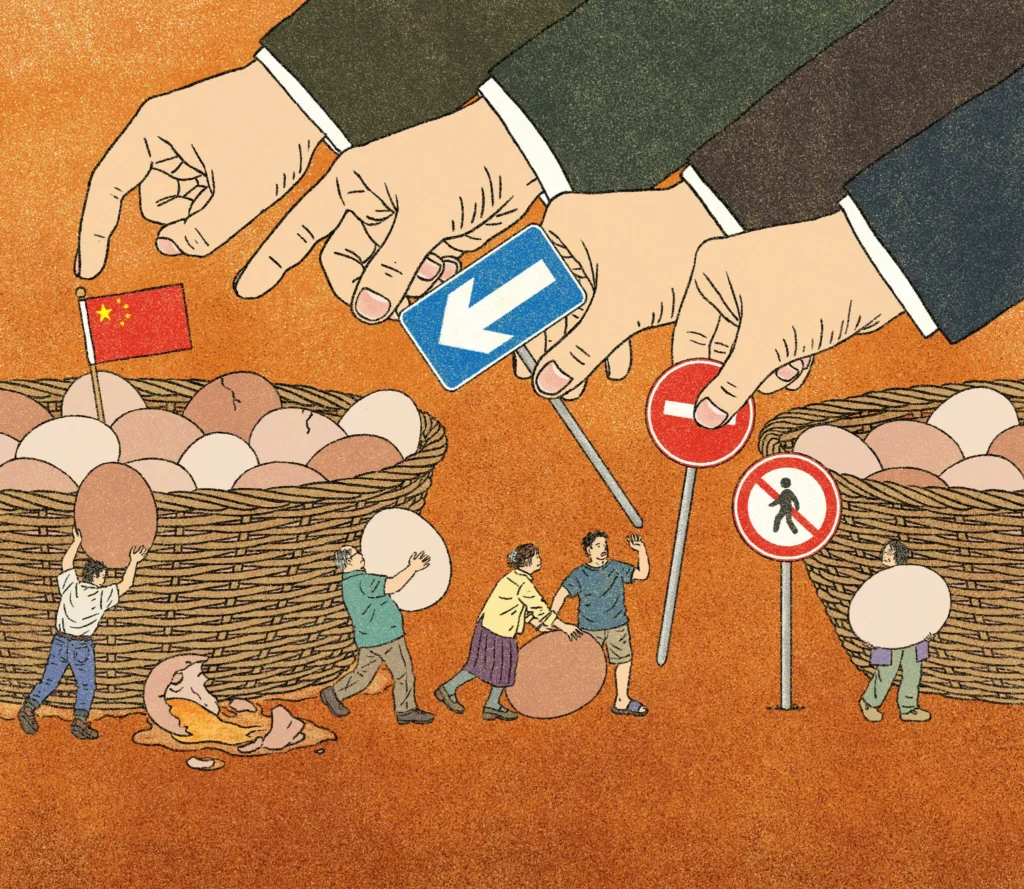
Beijing has long built walls between Chinese citizens and the outside world: The Great Firewall blocks out information, and passport controls and exit bans restrict movement. But money had been different.
In an unspoken bargain between the government and its people, political limits could be tolerated as long as families were largely free to accumulate, protect and quietly diversify their wealth.
That bargain is fraying.
Over the last couple of years, Chinese citizens have increasingly invested in overseas securities, and especially in the U.S. stock market. But in recent weeks, Beijing has moved to close informal channels between Chinese households and global capital markets. It gave several Hong Kong and Singaporean-based brokerages with significant mainland clientele two years to wind down those accounts. It expanded rules on overseas investment to explicitly cover individuals for the first time, threatening to confiscate vaguely defined “illegal gains.”
In Hong Kong, long a gateway to overseas investing for mainland residents, banks and brokerages have tightened requirements for opening an account. Some brokerages told their mainland clients that the clients could sell U.S. stocks but not buy them. The Chinese social media app known as RedNote announced that it had cracked down on posts teaching people how to open U.S. stock trading accounts.
Beijing is pulling every available lever to mobilize the nation’s private wealth as a resource for its state-led drive toward technological self-reliance and national rejuvenation. In a major speech published in January, China’s leader, Xi Jinping, argued that financial latitude must be subordinated to national security, warning that China must guard against not only the risks of opening up but also risks that are “deliberately engineered” by geopolitical adversaries.
Geopolitical considerations are shrinking opportunity for Chinese investors in other ways. Amid the intense rivalry between the United States and China, SpaceX excluded Chinese investors from its history-breaking initial public offering last week. At the same time, Beijing is erecting its financial walls precisely when ordinary Chinese have the most reason to look outward for more lucrative places to put their savings.
In the United States, stocks and bonds are the default investments for long-term savings. But retail investors in China tend to shy away from the country’s stock exchanges, known as the A-shares market, viewing it less as a vehicle for building household wealth than as a speculative arena swayed by policy, rumor and sudden state intervention. The market has many nicknames, including “the meat grinder.”
Instead, for two decades, middle-class families invested in real estate. The housing market was booming, and people bought apartments not just to live in but as retirement plans, college funds and assets for their children. Nearly one-third of urban households owned two apartments, and more than 10 percent owned three or more apartments, according to a 2020 survey by China’s central bank.
After the housing market collapsed in 2021, however, many people lost faith in the asset that had underpinned their sense of security. Already big savers because of the country’s spare social safety net, Chinese people retreated into defensive savings. By the end of 2025, China’s household bank deposits had reached the equivalent of $24.4 trillion, nearly tripling over a decade.
But that money is earning diminishing returns. Three-quarters of household savings are in fixed-term deposits. But those rates have fallen to around 1 percent, while high-yield savings accounts in the United States offer up to around 4 percent.
At the same time, the U.S. stock market kept going up. For financially sophisticated members of the Chinese middle class, overseas markets became a hedge against China’s economic slowdown, political uncertainty and weakening domestic returns.
The Institute of International Finance, a trade association based in Washington, estimated that resident capital outflows from China reached $809 billion in 2025, the highest level on record.
In 2025, Hong Kong overtook Switzerland as the world’s largest cross-border wealth management hub, partly driven by money coming from mainland China, according to Boston Consulting Group.
But Beijing increasingly sees this outflow of Chinese wealth as unpatriotic. Hu Xijin, a former editor in chief of the nationalist tabloid Global Times and one of China’s most prominent pro-government commentators, argued on the Weibo social media platform that the government’s latest moves served “the overall interests of Chinese society.”
“If stock investors buy more A-shares and fewer U.S. stocks, or if some people refrain from hastily selling their homes in China to buy property in the West, the overall effect would be positive,” he wrote.
Keeping savings at home and interest rates low is vital to Beijing. The country’s hugely indebted local governments have been restructuring their debts, relying on cheap domestic capital to ease interest burdens that consume roughly a fifth of their revenue. The savings are also backing China’s enormous investment in infrastructure, robotics, semiconductors and other industries deemed key to self-reliance and national security.
But that is not where sophisticated investors want to be. A technology worker who asked to be identified only by his last name, Xu, for fear of government retribution, has put as much money as China’s law allows into an American brokerage account since 2023.
Now all of the difficulties created by Beijing’s financial control leave Mr. Xu wondering, “Is my money still mine?”
Currently, Chinese citizens can legally convert their renminbi savings to $50,000 in foreign currency. Officially, that money can be used only for things like tourism or education, but using the quota for overseas investment in stocks or property has long been a tolerated gray zone.
For now, the quota remains the only legitimate opening for individuals to move money abroad. But there have been reports that banks are asking more questions about the use of the money, and people are worried that converting renminbi could become more difficult.
“So many people in the world can trade the U.S. stocks. Why can’t the Chinese?” Mr. Xu asked.
He is frustrated that SpaceX has excluded investors in China from participating in its I.P.O., the biggest in history. OpenAI and other potentially lucrative artificial intelligence companies may follow suit.
Others are now trying to slip under the wire and move their money abroad before the government blocks the passage completely.
In the past two weeks, investors feverishly traded workaround tips on social media and in group chats. Some flocked to Hong Kong to open bank and brokerage accounts at smaller firms with looser requirements. Others explored options to visit the United States and open accounts in person.
“No amount of financial controls can prevent people from moving their assets to places that offer better opportunities,” said Stephen, an I.T. worker in Guangdong Province who also asked to be identified by only one name.
- Credits: The New York Times
- Author: Li Yuan
- Illustration: Dongyan Xu