

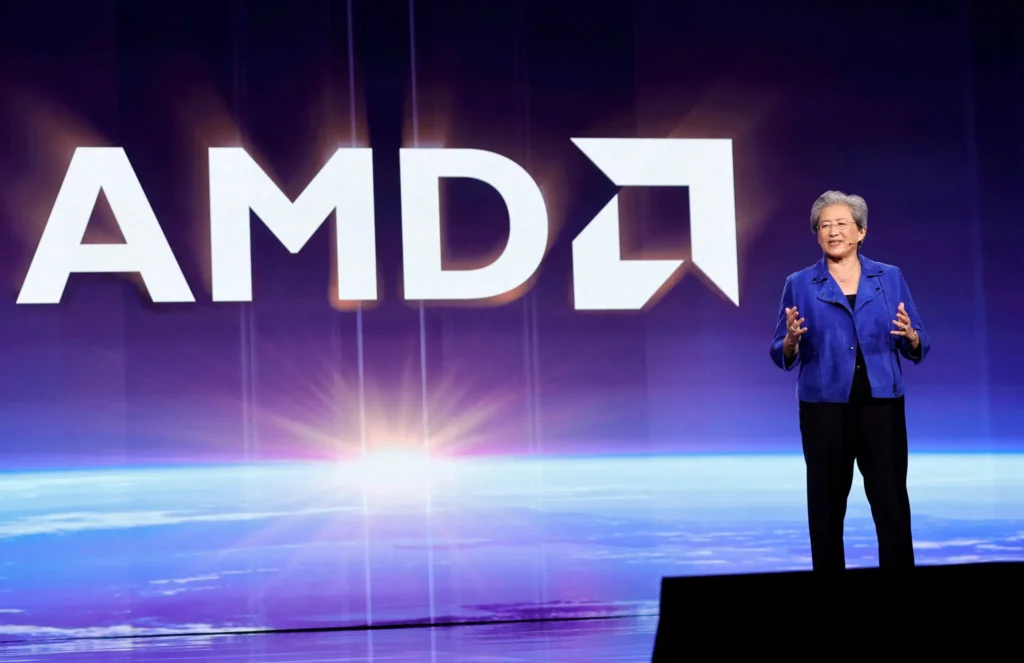
In recent months, Advanced Micro Devices has turned to a novel strategy in its race catch up to Nvidia in the lucrative world of selling artificial intelligence chips. The company has begun offering prized customers a sizable stake of its business if they bought its semiconductors.
AMD said on Tuesday that Meta would buy billions of dollars’ worth of its chips to develop A.I. technologies and power new data centers. As part of the deal, the social media giant can also take a financial stake of up to 10 percent in the chip developer, the two companies said.
In October, AMD struck a similar deal with OpenAI to provide chips in exchange for a financial stake.
The Meta-AMD agreement is the latest example of the kind of circular deals that have become a common feature of the A.I. boom. In recent years, Nvidia has invested billions of dollars in a number of customers, including the ChatGPT parent OpenAI, Elon Musk’s xAI and CoreWeave, a data center developer, that turn around and spend that money on the company’s chips.
Separately, Microsoft, Google and Amazon, which buy Nvidia’s chips for their data centers, have invested billions of dollars in OpenAI and Anthropic, which rely on the tech giants for computing power.
Those deals have led some Wall Street investors to question whether the A.I. boom is a bubble. The deals create a self-reinforcing loop between A.I. businesses, making it difficult to determine where demand for chips, data centers and software begins and ends.
“The cost of the A.I. build-out is so high that these are the only companies that can fund it,” said Gil Luria, head of technology research at D.A. Davidson, a brokerage firm. “They’re making a bet that the technology will be so powerful that ultimately everyone will be buying it from them, but if that doesn’t materialize, they’ll stop investing.”
(The New York Times sued OpenAI and Microsoft in 2023, accusing them of copyright infringement of news content related to A.I. systems. The two companies have denied those claims.)
As part of the multiyear deal with AMD, Meta is buying a volume of chips equivalent to up to six gigawatts of electricity, enough to power more than five million homes. The partnership with Meta will help place AMD “at the center of the global A.I. build-out,” Lisa Su, AMD’s chief executive, said in a statement.
Ms. Su’s creative deal making is helping AMD elbow into an A.I. market that has been dominated by Nvidia, the world’s most valuable company.
Nvidia pioneered the A.I. chip industry and claims a more than 90 percent share of the market. It has long counted OpenAI and Meta among its biggest customers.
Nvidia has been charging a premium for its chips, which outperform rivals’ offerings. But its high prices have made it costly for customers like Meta and OpenAI to build data centers. As a result, those businesses have begun to look for alternative chip providers.
Companies prefer to have choices to keep costs down, said Patrick Moorhead, president of Moor Insights & Strategy. He added that AMD had overhauled its chip design and supercomputers and created a product that was more competitive with Nvidia.
“Nobody thought AMD was a serious contender, but this says it’s not a one-hit wonder and has a strategy,” he said.
AMD’s stock jumped more than 6 percent in early trading. Nvidia’s stock fell 2 percent. Nvidia is set to release its latest earnings on Wednesday, a quarterly event closely followed by investors given the company’s outsize influence on major market indexes.
Meta said the deal was part of an effort to “diversify” the technology behind its data center infrastructure. AMD said that it would build chips to Meta’s specifications and that shipments would begin in the second half of 2026.
Meta also remains a major Nvidia customer. Last week, it agreed to spend billions of dollars on millions of Nvidia chips. The companies did not provide how many gigawatts of power the purchase would support.
- Credits: The New York Times
- Authors: Tripp Mickle and Adam Satariano
- Photo: Steve Marcus/Reuters