


A towering orange-and-white NASA rocket blasted off from Florida on Wednesday evening, lifting four astronauts toward space and transporting spectators’ imaginations to a future in which Americans may again set foot on the moon.
As they did during the heyday of the Apollo program, which first put men on the lunar surface, spectators squeezed onto the beaches along Central Florida’s Space Coast. The crowds cheered when the powerful vehicle launched into the clear, twilight sky at 6:35 p.m. Eastern time. It traveled eastward, over the Atlantic Ocean, on a journey that is to go around the moon but not land there.
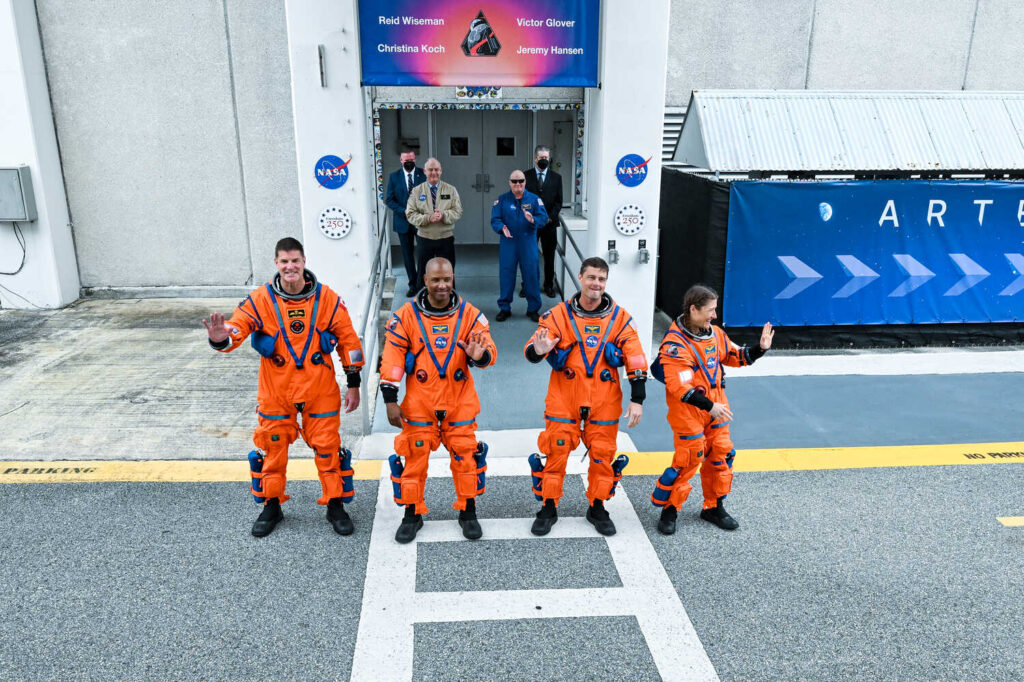
The flight aboard a spacecraft named Integrity is taking Reid Wiseman, Victor Glover, Christina Koch and Jeremy Hansen on what is expected to be a round trip of more than 695,000 miles to clear a path for more exploration, and eventually a new lunar landing.
The mission, known as Artemis II, is the 21st century equivalent of Apollo 8, when NASA astronauts Frank Borman, James Lovell and William Anders captured the rapt attention of the world. When they launched in December 1968, it was the first time that astronauts rode on top of NASA’s mighty Saturn V rocket. For that mission, instead of just a short test flight around Earth, the space agency audaciously decided to send the crew all the way to the moon and back, the first time that another celestial body became a destination that humans could reach.
Like Apollo 8, Artemis II aims to similarly check that the spacecraft can safely make the journey and keep its crew alive during the 10 days it is expected to take to go to the moon and return. Under those plans, the trip will conclude with a splash in the Pacific Ocean on April 10.
Unlike the Apollo astronauts, who were all white men, this mission sets a number of firsts: Mr. Glover of NASA will be the first Black man to venture into deep space and Ms. Koch of NASA will be the first woman to do so, while Mr. Hansen of the Canadian Space Agency will be the first person on a moon mission who is not an American. Mr. Wiseman of NASA is the commander of Artemis II.
In the 1960s, NASA was racing to beat the Soviet Union to the moon. This time, NASA does not want to fall behind the space ambitions of China, which is aiming to land its astronauts on the moon by the end of 2030. But the goal is not to win the sprint. It is to establish a continuing presence on the lunar surface, building an outpost over the next decade.
Jared Isaacman, a billionaire entrepreneur who became NASA administrator in December, has announced major revisions to the Artemis program and rallied a work force that was battered by uncertainty and downsizing last year to focus on putting new footprints on the moon by the end of 2028.
Here’s what else you need to know about Artemis II:
All Aboard: The rocket was filled with propellants and the astronauts on Wednesday afternoon were seen seated in the capsule well ahead of the launch. Forecasters predicted an 80 percent chance of favorable conditions during the two-hour launch window, which was set to start at 6:24 p.m. The window allowed wiggle room to resolve last-minute glitches or wait for a threatening cloud to pass by.
Technical Hiccups: Problems that have snarled scheduled launch attempts in the past, like hydrogen leaks and helium leaks, did not recur. But there were other issues. First, NASA engineers resolved a problem with the rocket’s flight termination system, which destroys the rocket in the event that the crew capsule is ejected during flight. Then, around 5:30 p.m. Eastern, NASA said it was working on a problem with a battery in that crew capsule ejection system.
Firsts in Flight: The Artemis II crew included several firsts. Mr. Glover, the pilot, is to be the first Black man to travel around the moon. Ms. Koch is to be the first woman, and Mr. Hansen would be the first Canadian to make the journey. While Mr. Wiseman, Mr. Glover and Ms. Koch have spent time on the space station, this will be Mr. Hansen’s first time off the planet.
Rocket and Capsule: The astronauts will get to space aboard the Space Launch System. The rocket is the equivalent of the Saturn V that NASA used during the Apollo moon landings. The S.L.S. is 322 feet tall and weighs 5.75 million pounds when filled with propellants. Once in space, the crew will separate from the rocket and travel toward the moon in the Orion capsule. It has the interior volume of about two minivans.
10 Days to the Moon and Back: The path of Artemis II is unlike any moon mission in the past and probably unlike any moon mission in the future. During the crew’s first few hours in space, they will test Orion’s systems while swinging out to about 43,000 miles above the Earth. That will set them up to begin their journey around the moon. The astronauts are expected to set a record for the farthest anyone has ever been from Earth, surpassing the distance reached by Apollo 13 in 1970 when the astronauts had to abort their mission and return back to Earth.
- Credits: The New York Times
- Author: Kenneth Chang
- Photos: Kenny Holston