
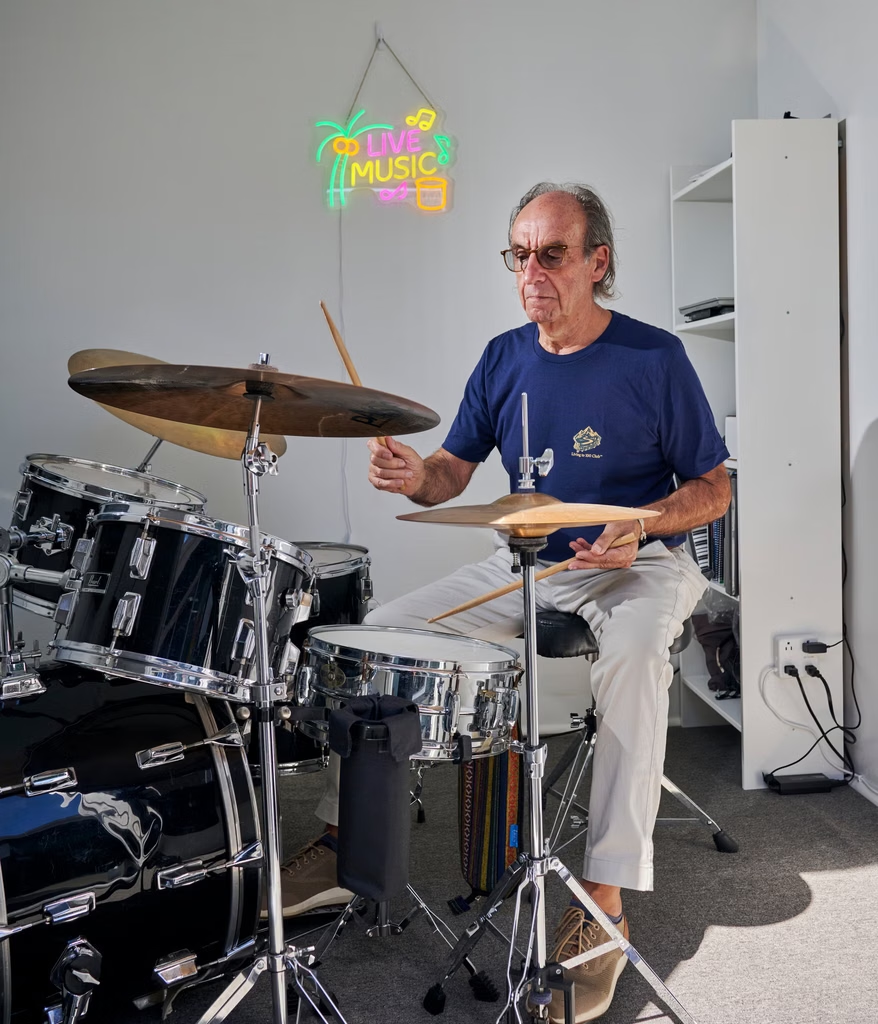
Joe Casciani, a 77-year-old psychologist, always dreamed of playing the drums. But with his busy work schedule, he never had the time to pursue this passion.
In 2019, he stepped back from clinical work and during the pandemic bought some electronic drums, playing them with a headset so his wife couldn’t hear. Now he has a soundproofed studio behind his house in San Diego and plays with a band once a week at a local senior center.
“My whole life has been so cerebral and I just love the physicality of drumming,” he said.
Mr. Casciani could be considered a retirement success story. He is hitting all the important marks experts say are key to fulfilling retirement: a sense of purpose, socialization and stimulating mental and physical activity.
That’s no accident. Mr. Casciani, whose website, the Living to 100 Club, focuses on aging well, was very aware of the common belief around getting older: It’s a steady decline both physically and mentally.
While he knows that is often a part of later years, he pushes back against a retirement where “we talk a lot about what we lose.”
“I like to put the spotlight on what we gain,” he said.
As more Americans live longer and as the population ages — the percentage of people 65 and older in the United States has nearly doubled over the past 50 years — retirement is now measured for many in decades, rather than years. Understanding what that means and how much control we have over the later stages of life has taken on a new urgency.
Not surprisingly, measuring the effect of retirement on physical, cognitive and mental abilities is a complex undertaking. It involves disentangling factors like career status and satisfaction, voluntary or involuntary retirement, socioeconomic class and financial stability, and overall health and health choices — such as smoking.
There is also the difficulty of separating the effects of aging versus those of leaving the workplace.
With all those caveats, however, a 2025 analysis of 22 studies between 2013 and 2023 on the impact of retirement on cognitive functioning — drawn from a variety of countries — suggests “that retirement tends to decrease cognitive functioning and increase the rate of decline.”
The international study, led by Chilean researchers, however, noted that “to fully establish a link between retirement and cognitive decline,” there must be more and better studies to reach a definitive conclusion.
Findings are also mixed in the area of physical health. So much in this area depends on the type of job and occupation one is leaving and why; retirement shows more benefits for those leaving physically demanding, low-quality jobs or poor working conditions.
Research does consistently show it matters significantly whether someone chooses to leave a job or is pushed out. Those who are forced to retire from highly satisfying careers that are a major source of their identity are more likely to experience depression after they leave the workplace than those who dislike their jobs or leave voluntarily.
Although the actual impact of retiring may be hard to tease out, there is more solid evidence about how to make the last stages of life as healthy and rewarding as possible.
But those are general guidelines, not prescriptions. For example, research shows that meaningful social connections are very important for both good physical and mental health, but it’s the quality not the quantity. Some need a wide group of friends they see frequently; for others, it can be a few close relationships.
Some studies have shown that in addition to friendships, joining or maintaining a membership in a group — something that meets regularly and is formed around a common interest — correlates with better physical and mental well-being in retirement.
Having a sense of purpose, while harder to define and establish than, say, an exercise routine or a book group, is increasingly seen as an important aspect of a satisfying retirement. It has been found in some studies to predict better physical health, and in others to protect against self-reported cognitive decline.
But purpose does generally decline over time, said Elliot M. Friedman, a professor of gerontology at Purdue University. During research for a paper that found sustained purpose in life is associated with slower cognitive decline, Professor Friedman and his colleagues looked at a decade of data from 9,800 Americans included in the Health and Retirement Study. Conducted by the University of Michigan, it used data from the Social Security Administration and the National Institute on Aging.
As part of that survey, participants were asked seven questions from what is known as the Ryff Scales of Psychological Well-Being to measure purpose, such as “I sometimes feel as I’ve done all there is to do in life,” or “I enjoy making plans for the future and working to make them a reality.”
There may be a number of reasons for reported decline in purpose as people age, Professor Friedman said. But he added that “opportunities for purpose and meaning in later life are just fewer and farther between as older people are expected to slowly detach themselves from society.”
There are even debates about how to define purpose. Is it doing something that benefits others? A legacy that lives on after death?
“Purpose manifests in different ways, so there’s not a one-size-fits-all,” said Patricia A. Thomas, an associate professor of sociology at Purdue and a co-author of the paper on sustained purpose in life. “Focusing on the small things that make you feel like you want to get up in the morning might be a simpler way to look at it than this giant, ambitious type of goal. It’s the small acts that can still be very meaningful and that can contribute to better cognitive function, better health and longevity in general.”
For example, Professor Thomas’s grandmother, Eileen Veselka Thomas, 95, retired from her job as a full-time nurse at 70 after her husband died. She continued to work part time until she was 88 as a registered nurse, but also joined a writing group led by professional authors and traveled widely.
She has finished a work of historical fiction around the conquest of Mexico, which has been accepted by a publisher.
“I had been wanting to write the book for years before I actually began, but I was too busy with my job and family,” she said in an email interview.
Ms. Thomas said she does not feel she has experienced cognitive decline as she has aged, so she doesn’t think writing the book has helped keep her mentally sharper, “but other people think it has.”
Ms. Thomas’s retirement crystallizes many of the trends experts see these days that can be connected with slowing down physical and mental health deterioration — including her decision to keep working part time after retiring and joining a writing group. Or in the parlance of academia, engaging in bridge employment and lifelong learning.
In Sweden, for example, the proportion of individuals who continue to work after starting to withdraw their pension has doubled, said Isabelle Hansson, a co-author of the study “Retirement as Risk or Relief?”
“On average, one-third of retirees continue to work in some way or another after retirement,” she said. “That shows that retirement is no longer like a permanent exit from the labor market.”
Whether later employment has a positive effect on health and well-being depends on why someone is looking to work; having to because retirement income and savings fall short can cause more stress versus wanting to work for enjoyment or a sense of purpose.
But even as people can try to fashion their lives to be as meaningful and healthy as possible in the latter years, much is out of their control. These include socioeconomic class, and the lack of affordable programs that serve the aging and support caregiving.
The Stanford Center on Longevity, with its New Map of Life, lays out a world where schooling, work and time-off are far more integrated and overlapping throughout a lifetime than they are currently.
“In the United States and beyond, 100-year lives will be common for those born today,” the introduction to the map states. “Yet, the social institutions, norms and policies that await these future centenarians evolved when lives were only half as long and need updating.”
Perhaps most important, people need to realize that the type of retirement they experience grows out of the type of life they have lived. Learning to be curious about the world, volunteering to help others and developing friendships has to start much earlier than 65.
As Baowen Xue, an associate professor at University College London and a co-author of a paper on the effect of retirement on cognitive functioning, said in an interview: “Your life after retirement already started when you were a baby.”
- Credits: The New York Times
- Author: Alina Tugend
- Photo: John Francis Peters