
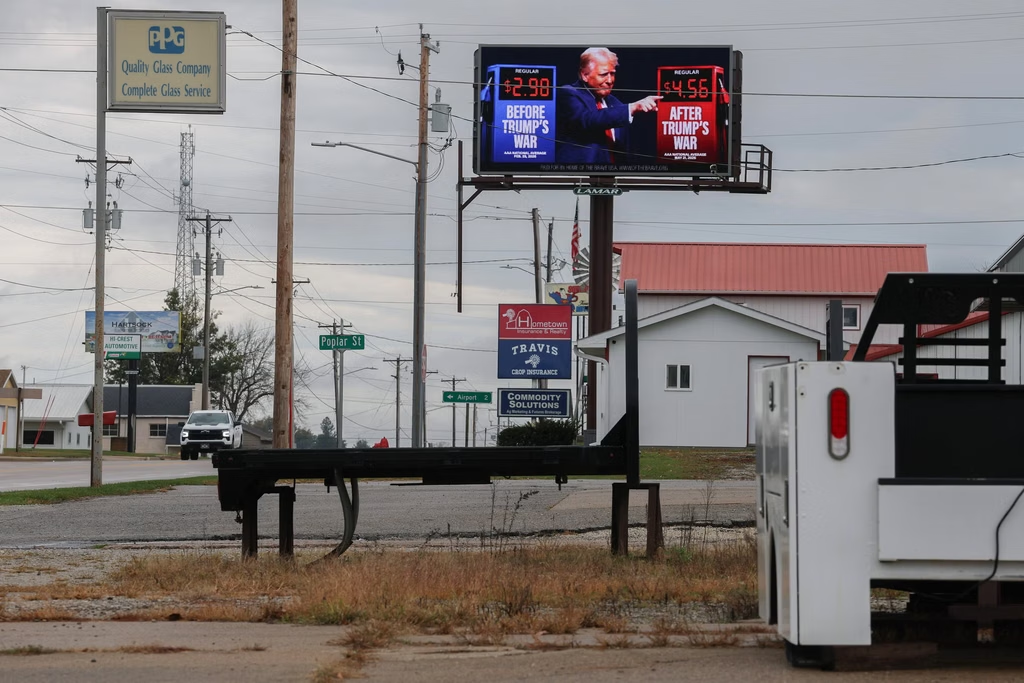
Financial concerns have been the most pressing issue for voters in four of the six previous midterm elections of this century. But with the war in Iran and tariffs driving up gas prices, inflation and mortgage rates, the worries feel deeper, more desperate and decidedly center stage in the final days of the hard-fought campaign that will decide control of Congress.
Democrats are hammering President Trump for starting a war with Iran and instituting tariffs that have driven up prices, while Republicans are insisting the fundamentals of the economy are stronger than before they took power two years ago. And polls show that pocketbook issues are once again top of mind for many voters.
If presidential elections are about a vision for the future, midterms give voters a chance to offer their verdict on a president, a Congress and, almost always, the nation’s economic health.
Over dozens of interviews across the country in recent days, Americans from across the political spectrum detailed the financial gymnastics of keeping pace with rent hikes and mounting utility bills, along with rising prices for gas, groceries and even Halloween candy. Many voters directly blamed Mr. Trump and his party for the high cost of living.
“The prices of everything we normally buy have gone up and up dramatically,” said Dwayne Stanford, a father of eight in suburban Cincinnati, who chose only Democratic candidates during early voting in his state. “It’s just the everyday stuff.”
“Everybody’s feeling it in terms of inflation,” said Bret Rhodus, 52, an independent voter from Douglas County, Kan. “College costs, because I’m kind of in that stage of life. But even, like, the price of a pizza.”
“It’s expensive,” said Sophia Gallerani, 80, a retiree who said she cast her ballot for the Republican ticket on the first day of early voting in Tucson, Ariz. “Basic needs like eating and gas for getting to appointments if I have any or going to church.”
The worries of voters, which cross lines of generation and gender, race and political ideology, reflect the anxieties of a country convinced that the American dream is slipping away. In polls, focus groups and interviews, voters described some of the traditional promises of a middle-class life — health care, a college education, homeownership and retirement — as becoming rapidly unaffordable. They fear their children will live a worse life than they do.
“I have a degree, I have a good job, but it is still a stretch to pay for basics like groceries and utilities,” said Brandi Kelly, 43, of Dayton, Ohio. “It is harder to just maintain what we have had.”
Presidents often shoulder the blame — and occasionally the credit — for an American economy that they have limited ability to directly control. But Douglas Holtz-Eakin, the former chief economist for President George W. Bush’s Council of Economic Advisers and current president of the conservative American Action Forum, said that old political maxim doesn’t totally apply when it comes to Mr. Trump and some of the signature policies of his administration.
The war with Iran raised gas prices, and tariffs made foreign goods more expensive for U.S. purchasers. The rising costs have outpaced workers’ hourly wages, according to the government, compounding the financial stress already felt by many American families.
“The standard of living is declining and people know that,” Mr. Holtz-Eakin said. “The nature of these actions have really allowed voters to blame him.”
Democrats have driven a message of blaming Mr. Trump for the high costs. Expanding on a theme of “affordability” that the party rode to success in the races for governor in 2025, Democratic candidates and their allies have spent nearly a half-billion dollars on ads mentioning the economy, prices and inflation, according to AdImpact.
In Maine, Troy Jackson, the Democratic Senate nominee, has transformed surging heating oil costs into a central line of attack against Senator Susan Collins, the Republican incumbent.
In North Carolina, former Gov. Roy Cooper, the Democratic Senate nominee, has spent weeks on a “Make Stuff Cost Less” campaign tour, introducing plans to lower the price of food, health care, utilities, child care and housing.
And in Texas, supporters of Gina Hinojosa, the Democratic nominee for governor, wave money-green signs with one of her central campaign promises: “Money in your pocket.”
Even in races dominated by questions of character and corruption, Democrats have steadfastly returned to high costs as the central building block of their political argument.
“We can’t afford the basics in this economy — gas, groceries, utilities, health care — because the system has been rigged by billionaires and crooked politicians like Ken Paxton,” James Talarico, the Democratic Senate nominee in Texas, told a cheering crowd at the Kay Bailey Hutchison Convention Center in Dallas on Thursday evening, referring to his Republican opponent. “This election is about whether you want a senator who puts money in your pocket or money in their own.”
As he crisscrosses the country on a whirlwind campaign tour, Mr. Trump has tried to argue that the economy is strong, growing and rife with new investment. Markets are riding high, consumers are continuing to spend and gross domestic product is increasing, according to recent measures.
But as Mr. Trump’s predecessor, former President Joseph R. Biden Jr., learned during his term in office, voters don’t care how government reports assess the economy. They care how it feels.
“The problem is that the one metric people use to judge the economy is gas prices,” said Steve Moore, a conservative economist who advised Mr. Trump’s first presidential campaign. “You see it wherever you go, with a big sign.”
Some of Mr. Trump’s most devoted supporters continue to profess their loyalty, even as they describe enduring economic pain.
Brenda Pruitt, a three-time voter for Mr. Trump, said she had spent more than $100 on gasoline to drive to Ohio from Kentucky to see the president and other Republican candidates speak at a rally in Chillicothe, Ohio, on Wednesday,
“I’m feeling the inflation, but I’m willing to take less in order to help the American people,” Ms. Pruitt said.
At the rally, Mr. Trump touted the performance of the stock market and higher incomes while blaming Democrats for voting for policies that led to higher prices.
“They voted in favor of the worst inflation and highest energy costs in American history,” Mr. Trump said.
That’s an argument Mr. Trump spent much of 2024 making. More than any other issue, his rise into the White House was fueled by attacks on Mr. Biden and Vice President Kamala Harris for high inflation and promises to lower soaring prices.
Two years later, with inflation rising once again, large numbers of voters have shifted blame to Mr. Trump. Views of his handling of the economy — one of his biggest strengths when he ran on two years ago — are now underwater. Majorities disapprove of his handling of tariffs, the economy, gas prices, the cost of living and the Iran war. Fifty-three percent of likely voters considered the economy as “poor” in the recent New York Times/Siena poll — the worst rating since July 2022.
Mr. Trump promised to lower inflation; it’s now accelerated to 3.7 percent. He vowed mortgage rates would return to as low as 2 percent. They are currently above 7 percent. And surging fuel prices have increased the costs for farmers, truckers and consumers to heat their homes, plow their fields and commute to work.
Republican efforts to defend the president’s policies, despite growing anger from voters, have fueled Democratic optimism in some surprising places. A clip posted in February of Senator Cindy Hyde-Smith, a Republican from Mississippi, responding to concerns about rising beef prices by saying consumers “have so many proteins to choose from,” helped transform her race in a deep red state into a competitive contest.
Her opponent, Scott Colom, has gained ground with a simple slogan: “High wages, lower costs, save our health care.”
In Kansas, Senator Roger Marshall, a Republican, was slow to respond to the rising costs of fertilizer, fuel and feed that have hammered farmers and ranchers in his agriculture-heavy state. The race, which was not on either party’s list of battleground states last year, is now considered one of the most competitive in the country.
“This is one of the best economies I’ve ever seen in my lifetime,” Mr. Marshall said at a campaign stop last month. “We just have to get the price of gas and groceries down.”
The White House has tried to find ways to offer consumers some relief, announcing a series of policies in the final weeks of the campaign that included $90 payouts for millions of seniors on Medicare, $500 rebate checks for some Affordable Care Act customers and a decision to allow Russian diesel imports after years of sanctions.
Mr. Trump has also promised a $5,000 check to every American adult if his party retains control of Congress in November. The plan would require congressional approval and cost more than $1 trillion.
But for many people, such policies are coming too late to affect their finances — or their votes.
As Carmen Moreno, 50, waited to hear Mr. Talarico address the crowd in Dallas, she expressed astonishment at the increase in the cost of food. A recent trip to Denny’s with her mother cost $63, she said.
Ms. Moreno, an entrepreneur, is hopeful Mr. Talarico and a Democratic-controlled Congress can help restore an American middle class that she worries is slipping away.
“We are living in a time with a lot of economic distress,” she said. “And there’s just a total lack of accountably in Congress right now. Like, what is going on?”
- Credits: The New York Times
- Authors: Lisa Lerer and Alan Rappeport
- Photos: Anna Moneymaker/Getty Images