
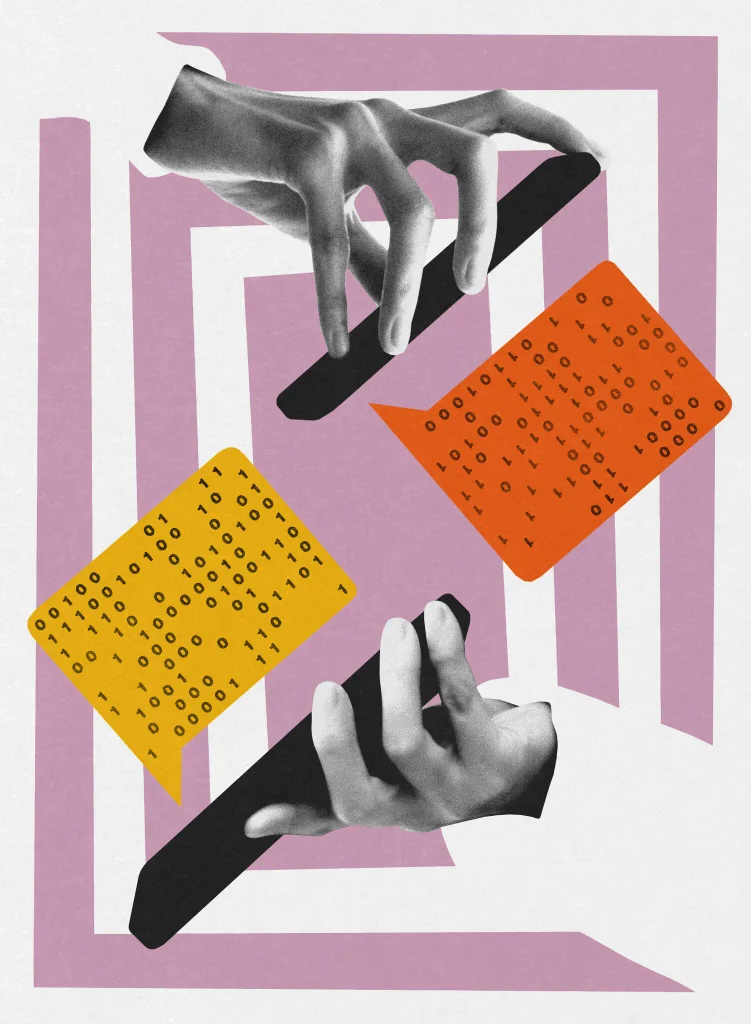
If you haven’t applied for a job recently, you might be surprised by the new common procedure. At one end, job seekers use A.I. chatbots to churn out résumés and cover letters. At the other, employers use A.I. to sift through all of those applications. People on each side of this equation say they need these tools to keep up with the other. But the result feels hollow, impersonal, frustrating. Are people actually getting to know each other better?
This sort of thing is happening everywhere. Consider a high school student who asks an A.I. chatbot to write an essay that she submits to a teacher, who then uses A.I. to grade it. Or a person who asks a chatbot to write a witty opening line to a romantic prospect, who then uses a chatbot to generate a flirty response. Or a person who sends his A.I. agent to go argue with a company’s A.I. customer service system.
“We’ve officially reached the point where customer support is just two LLMs locked in a recursive loop of ‘I understand your concern,’ while the actual humans on both ends just watch the credits roll,” one Reddit user wrote recently.
Many of us have spent the past couple of years getting used to the strangeness of humans adopting chatbots as conversational partners. But now, as more of us complete everyday tasks with A.I., all of those directives are bumping up against one another. I’ve started calling these situations “bot loops” — the little whirlpools that spin up whenever humans on each side of an interaction outsource their roles to A.I.
My bot, my self
Some people are hopeful about the potential for these bot-on-bot interactions to streamline our work and personal lives. It’s not crazy to think that an A.I. voice agent could someday call the Department of Motor Vehicles for me, and that another A.I. agent could answer the phone. If it saves me a trip to my local D.M.V. in Brooklyn, where dreams go to die, I’m certainly interested.
Whitney Wolfe Herd, the chief executive of the dating app Bumble, has suggested that our A.I. personas will eventually go on dates with each other and report back to us with the results. (When one of my colleagues tried this, it did not go especially well. Better luck next time, Eli!)
Still, the experts I talked to for my new story about bot loops in The Times Magazine told me there’s a lot to worry about. A.I. systems get things wrong; string a bunch together and they could amplify one another’s errors. And there’s fascinating research emerging about so-called A.I. self-preference bias — the tendency for these systems to favor their own work. In other words, an A.I. recruiter will probably rate a résumé generated by ChatGPT more highly than one written by a human.
But the thing that unsettled me most while reporting was the way that bot loops strain human relationships. The journalist Evan Ratliff thinks it’s hard to blame job applicants for using A.I. when companies don’t even bother to send real interviewers. “Once it’s a little bit debased, you do eliminate the incentive for people to show up as their authentic selves,” he said.
It can be nerve-racking to show up if you don’t know whom (or what) you’ll be dealing with. Ratliff has spent a lot of time experimenting with A.I. voice agents for his podcast, “Shell Game.” When I first got on the phone with him, I found myself scrutinizing his small talk to determine whether I was speaking with him or his bot. A few minutes later, we were both laughing. It turned out he had been wondering the same thing about me.
- Credits: The New York Times
- Author: Callie Holtermann
- Photo illustration: Chantal Jahchan