
The baby started turning blue almost immediately after she was born in a small clinic last month in South Korea.
There was a neonatal intensive care unit a short drive away, but the specialist there had reportedly resigned recently after years of grueling 90-hour work weeks. Another did not have any free beds. So the clinic’s staff rushed the newborn, who was struggling to breathe, to a third hospital. That facility was 30 minutes away by car, and by the time she got there, she died.
The clinic later learned that the first NICU had been staffed by another specialist that night who could have treated the baby. But many in the medical community had assumed that the nearby facility had not filled the vacancy because of a growing shortage of specialists.
Her death, in the western city of Jeonju, detailed by lawmakers in parliament and local news media, was part of a bigger crisis in South Korea: a widening gap in emergency care. The shortage of neonatal doctors is particularly alarming because the country has been trying for years to increase its fertility rate, which is among the world’s lowest.
As the birthrate dropped below replacement level in the 1980s, South Korea has gone through profound changes. Thousands of schools have closed in recent decades. Over 40 percent of day care centers have shuttered in recent years. The number of pediatricians, delivery wards and neonatal physicians is plunging every year.
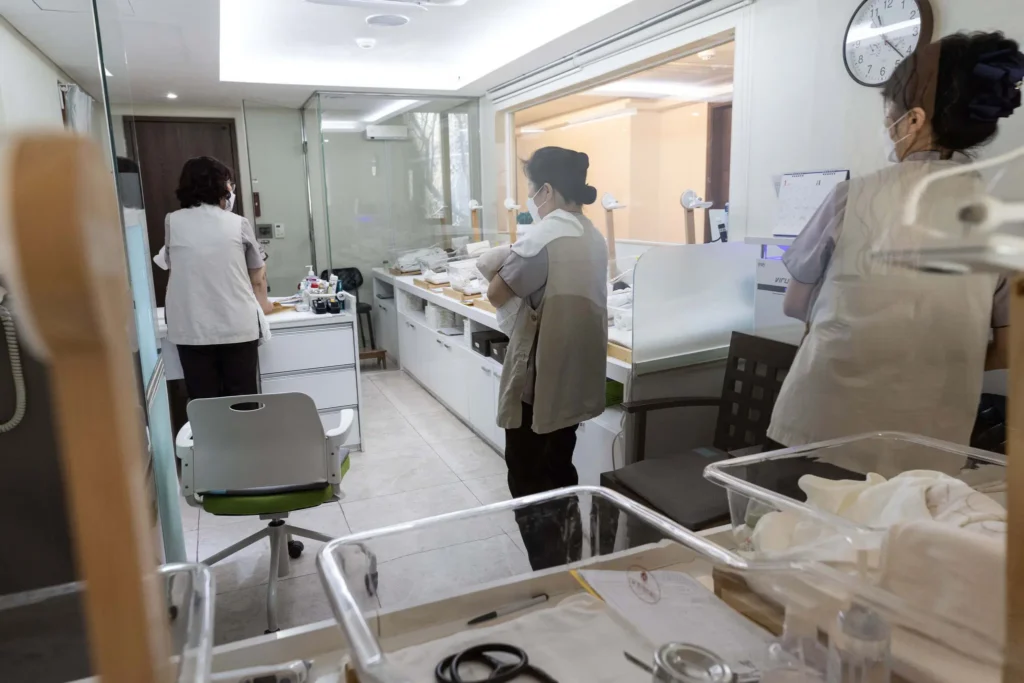
Now the country has 77 NICUs where 240 specialists are tasked with caring for some of the most vulnerable patients, according to the government and doctors groups. The shortage is the most acute outside the greater Seoul area, the country’s population center. Some hospitals outside the capital only have one specialist to care for over 30 babies at once, doctors say.
Neonatal doctors say that government measures to reverse the birthrate have done little to improve their working conditions — long hours, low pay and litigious patients. These concerns echo those from the wider medical community in South Korea and contributed to an 18-month walkout by thousands of doctors that ended last September. The future of the neonatal specialty is particularly dire: The number of residents working in NICUs has decreased by 94 percent in recent years, according to government data.
Young-Ah Youn is a teaching doctor at the neonatal department of Seoul St. Mary’s Hospital. She said that during her 16-year career as a physician, she has worked more 100-hour weeks than she can count, particularly during her early years as a junior faculty member. Now her department does not have any residents, raising questions about the future of the ward.
“Who would want to work here when there’s so little support or protection for us?” she said. The hospital relies on contract doctors or nurse practitioners to fill in staffing gaps.
Government efforts, doctors argue, have been focused on increasing the birthrate. Over the past two decades, South Korea has invested the equivalent of hundreds of billions of dollars in programs like cash stipends for new parents, egg freezing procedures for women and free wedding venues for soon-to-be spouses. But experts say the outlays have not tried to secure the medical infrastructure to provide adequate care for the nation’s youngest citizens.
There is still “an imbalance in incentives to ensure adequacy in trained medical specialists,” said Professor Tan Poh Lin, a pediatrics expert who teaches public policy at the National University of Singapore. She added that policy focus has been “overly oriented toward the family formation process.”
The Korean Society of Neonatology has described government policy that encourages people to have children while largely ignoring a lack of emergency medical care for newborns as a “paradox.” NICUs outside the Seoul metropolitan area, it said in a statement last month, are near “a state of catastrophe.”
The government has announced that it would increase fees for deliveries and high-risk procedures — a move designed to raise doctors’ pay. It also said that it would increase the number of dispatchers on call at the National Medical Center’s Central Mother and Child Medical Center to expedite emergency transfers.
Choi Han-seon spoke about her premature delivery and the importance of NICUs at a policy forum at the National Assembly in June. She needed surgery after a hemorrhage in the 20th week of her pregnancy. Her son was born three weeks later, only weighing about 1.4 pounds, and had a series of health complications like high blood pressure and a brain hemorrhage.
He was left with developmental disabilities, but survived after nearly five months in a NICU. Ms. Choi said, “NICUs are not an option, they are an essential service that saves the lives of babies.”
But if the number of neonatologists continues to dwindle in South Korea, that care may be at risk.
“I’ve worked tirelessly out of a sense of duty,” Professor Youn said. “But I fear that, if things continue this way, there will soon be no one left to care for these babies.”
- Credits: The New York Times
- Author: Jin Yu Young
- Photo: Jean Chung