

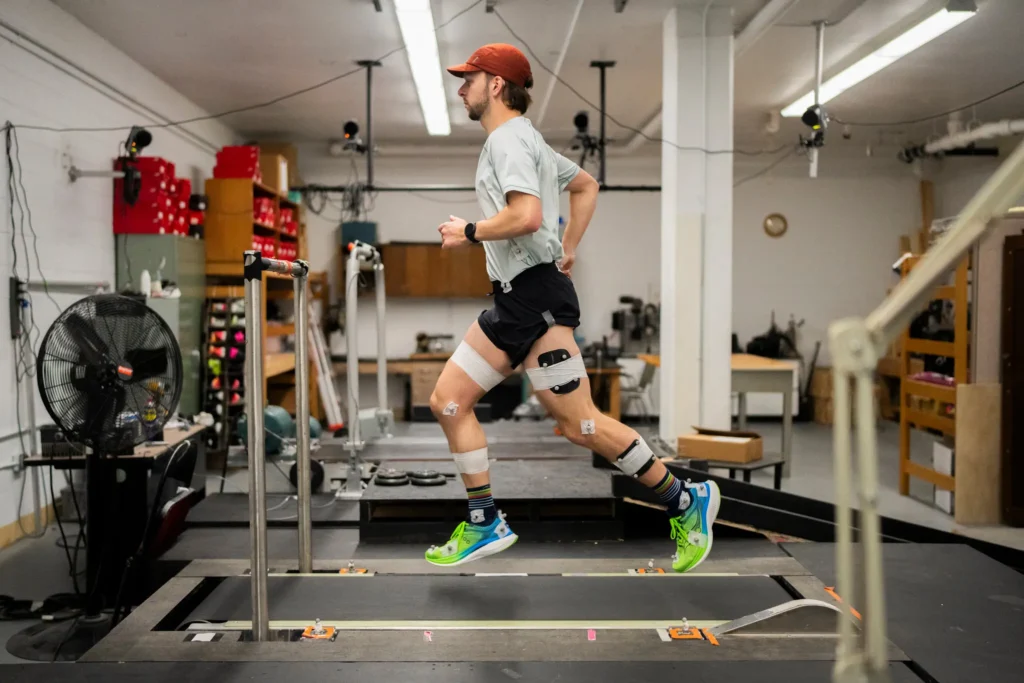
In early 2024, Max Grüttner, the head of performance concepts at Puma, was examining the results of tests conducted by the company’s research and sports science department at its lab in southern Germany. His team was developing a new long-distance “super shoe,” the Fast-R Nitro Elite 3, with a newly formulated thermoplastic polyurethane foam and a spoon-shaped carbon fiber plate. The early lab results looked promising — almost preposterously so.
Each of the athletes Grüttner’s team had hooked up to research-grade treadmills showed improved “running economy” — a measure of the amount of metabolic energy they used to maintain a consistent speed — while wearing the Nitro Elite 3, compared with other leading shoes. In theory, this meant someone could run a faster or easier marathon wearing Pumas than competing brands, which is the dream of every running-shoe designer. If this claim were validated, it could make the Nitro Elite 3 a must-buy for marathon runners all over the world.
But Puma had to test it at a lab that wasn’t affiliated with the brand, so Grüttner mailed prototypes of the Nitro Elite 3 to the Integrated Locomotion Laboratory at the University of Massachusetts Amherst, run by Wouter Hoogkamer, an expert in biomechanics and energetics.
Hoogkamer is highly respected in the footwear industry for a paper he wrote with Rodger Kram, a physiologist who ran the Locomotion Laboratory at the University of Colorado Boulder. The 2018 study revealed that Nike’s then-unreleased super shoe, the Vaporfly, “lowered the energetic cost of running by 4 percent on average,” which could help top athletes “run substantially faster” — a claim so provocative that it was met by calls from a major sports governing body for the shoes to be banned.
Hoogkamer conducted a study of the Nitro Elite 3, testing its performance against the Nike Alphafly 3, the Adidas Adios Pro Evo and its predecessor, the Nitro Elite 2. Of the 15 athletes tested, Hoogkamer found that each “recorded their best running economy in the prototype shoes.” The study concluded that the Nitro Elite 3 could improve running economy by approximately 3.1 to 3.6 percent compared with state-of-the-art marathon shoes, an enhancement that could allow a three-hour marathon runner to shave about four and a half minutes off her personal best.
Grüttner was thrilled. “They replicated our results,” he said. “Now it wasn’t just our lab. It was an external lab.”
Hoogkamer published the results alongside a “competing interests” addendum disclosing that the author “has received research grants from Puma.” Last year, Puma issued a news release that asserted it had scientific data to prove Puma’s Fast-R Nitro Elite 3 was “leading” in the running category to promote the shoe’s debut at the Boston Marathon.
Carson Caprara, the chief product officer at Brooks Running, a rival shoemaker, said that such scientific studies were useful learning tools for brands. But testing protocols, he said, are often too narrow: The Massachusetts Puma study and the Colorado Nike study both involved having athletes run on treadmills for only five minutes at a time.
“You glean a lot from five minutes, but you have to infer a lot as well,” Caprara said. “That’s maybe more about the press release and less about the complex truths that go into a shoe working to its full extent.”
Running shoes often boast about their scientific bona fides. A magazine ad for the Nike Air Max 1 from the mid-1980s trumpeted the company’s “passion for science,” adding technical jargon to appeal to the savvy runner’s desire for some quantifiable performance edge. And many in the footwear industry studied sports science and biomechanics, like Matthew Nurse, Nike’s chief science officer and longtime head of the Nike Sport Research Lab, who worked at the Human Performance Lab at the University of Calgary, in Canada. Grüttner has a master’s degree in sports science and kinesiology.
But it wasn’t until Nike released the Vaporfly ahead of Eliud Kipchoge’s sub-two-hour marathon attempt, in 2017, that a brand commissioned an academic study of its shoe technology. While developing a prototype in 2016, Nike engaged Kram, a member of Nike’s scientific advisory board, to test the shoe’s effectiveness against other leading marathon footwear. The result — that the Vaporfly was 4 percent better than the competition — was extensively reported in the press. The shoe was eventually released under the name “Vaporfly 4%.”
“It really added to Nike’s credibility and validated our approach,” said Ray Browning, then Nike’s director of footwear.
But promoting a new shoe with an academic study elicited skepticism.
“If Nike had just put out an ad that said, ‘Our shoes are 4 percent better,’ or, ‘Our runners say that their runs feel 4 percent easier,’ nobody would have paid attention,” Kram said. “When you put out a study, that’s different. That’s making a pretty bold claim.” Even as athletes began to set world records in the shoes, “healthy doubt was hard to kill,” the journalist Matt Hart wrote in his book “Win at All Costs.” “Owing to the fact that Nike had funded the study.”
“People said we were shills,” Kram said. “But then the study got replicated.” In 2019, a New York Times analysis found that the advantage conferred by the Vaporfly might actually be even higher than concluded by Kram.
Vaporfly’s success ushered in an era in which every brand was hurrying to develop a super shoe that combined high-stack supercritical foams with carbon fiber plates. It also put a new emphasis on scientific analyses, as every company looks for ways to prove, with hard data, that its shoe has something that the others don’t. “A lot of those people have worked with Rodger and me, so it’s becoming omnipresent at the shoe companies,” Hoogkamer said.
Some brands, like Under Armour, have built state-of-the-art laboratories in pursuit of a competitive advantage. Tom Luedecke, Under Armour’s senior director of footwear innovation, described its newly constructed mechanical testing lab in Baltimore as “world-class, and as good or better than everyone else in the industry,” crediting it with the success of the brand’s Velociti Elite line of marathon-running shoes. Other brands have deepened their relationships with universities to leverage their resources and expertise.
“Working with these labs makes us a lot smarter,” said Kevin FitzPatrick, the vice president for running at New Balance.
Not every brand relies on external data. When Adidas revealed its Adios Pro Evo 3, which Sabastian Sawe wore in April when he ran the London Marathon in under two hours, it boasted that the shoe “improves running economy by 1.6 percent compared to its predecessor.” But they didn’t share any studies or data, which raised eyebrows.
Marc Makowski, senior vice president for innovation at Adidas, said that the company goes through “an extensive testing process, looking at all kinds of impacts from a biomechanics perspective.” Those tests take place both in Adidas’s in-house lab at its Bavarian headquarters and “in the field in places like Kenya,” replicating conditions where athletes like Sawa live and train.
“It’s amusing that the unattributed 1.6 percent number quoted by Adidas is just being treated as if it were fact,” said E.C. Frederick, a biomechanist who founded Nike’s first Sport Research Lab in the early 1980s.
“Facts need to have, at least, an origin story,” he added.
Tom Berend, an industry veteran who worked at Nike for over 15 years before becoming the head of design and innovation at R.A.D., an upstart shoe company based in Oregon, said he sees the upside in intense testing.
“I do think it’s good for our industry to test this stuff,” Berend said. “Good for fans, for consumers.” But he has seen a lot of grandstanding. “Companies pay huge amounts of money for lots of those studies to happen. I’m not saying they’re entirely inaccurate. But the real proof is when you put that product on real athletes, people who run every day, and they tell you, ‘This is what I’ve been looking for in a shoe.’”
- Credits: The New York Times
- Author: Calum Marsh
- Visuals: Christopher Capozziello