
The “Odyssey” is a 2,800-year-old, 12,000-line poem. This summer, it’s also a major motion picture, starring Matt Damon as the wily, beleaguered Bronze Age hero Odysseus, a veteran of the Trojan War trying to get home to his wife, Penelope, and their son, Telemachus.
It’s a 10-year journey, during which Odysseus contends with raging storms, seductive sirens, an angry Cyclops and a gaggle of local horndogs trashing his house and threatening his marriage. Penelope does what she can to hold off those suitors; Telemachus tries to fill his dad’s shoes; and the gods of Olympus work out their own family issues by meddling in the affairs of mortals.
It’s an amazing story. Really, it’s all the stories. The “Odyssey” is a venerable literary masterpiece, but in its time the poem was also popular entertainment, performed aloud by virtuosos known as rhapsodes. (One of these original rappers may or may not have been named Homer.) What kept their listeners enthralled was variety: This epic is full of comedy, pathos, adventure and suspense.
As the critic and classicist Daniel Mendelsohn puts it in the introduction to his recent translation, “The ‘Odyssey’ bequeathed to the West entire genres,” from science fiction to romantic comedy. In that spirit, we offer this guide, confident that whatever kind of story you’re looking for, you’ll find it in Homer.
I want adventure on the high seas
Patrick O’Brian, the all-time master and commander of nautical dad-lit, has nothing on Homer. Odysseus’ winding journey home to Ithaka takes him all over the Mediterranean, and much of the peril he faces comes from the water. He is a capable sailor, though he also loses countless friends and ships to the fury of the sea and his own shaky judgment. It doesn’t help that Poseidon, the god who rules the ocean, holds a serious grudge against our hero.
Homer and his translators know that few things are more elementally thrilling than the story of a man and a boat at the mercy of the weather.
A great wave drove at him with toppling crest
spinning him round, in one tremendous blow,
and he went plunging overboard, the oar-haft
wrenched from his grip. A gust that came on howling
at the same instant broke his mast in two,
hurling his yard and sail far out to leeward.
(translated by Robert Fitzgerald)
I like science fiction and fantasy
We still wonder what lies beyond the boundaries of the known world, and we send out voyagers and vessels, imaginary and real, to discover new landscapes and life forms. Odysseus wasn’t looking for any of that, but we can infer that Homer’s audience was eager to hear about monstrous creatures and magical islands. The poem has a lot of them — sometimes dreamy and alluring, sometimes scary and violent. Kind of like the planets the Enterprise used to visit on “Star Trek,” a franchise that owes quite a lot to Homer.
In Book 10, Odysseus recalls a harrowing encounter with enormous man-eating beings who inhabit an island called Lamos.
Hearing, the mighty Laestrygonians
thronged from all sides, not humanlike, but giants.
With boulders bigger than a man could lift
they pelted at us from the cliffs. We heard
the dreadful uproar of ships being broken
and dying men.
(translated by Emily Wilson)
How about a spooky ghost story?
After escaping the Laestrygonians (and spending some time with a sorceress named Circe), Odysseus sails to the edge of the ocean, a liminal zone where the living and the dead commingle. In the underworld he meets a blind seer, Tiresias, who foretells his future, after which Odysseus encounters the ghosts of his mother and some of his fallen comrades from the Trojan War. The mood in this section shifts back and forth between terror and pathos, a reminder that even in the ancient world supernatural horror was bound up with intense human emotions.
Then in my heart I wanted to embrace
the spirit of my mother. She was dead,
and I did not know how. Three times I tried,
longing to touch her. But three times her ghost
flew from my arms, like shadows or like dreams.
Sharp pain pierced deeper in me as I cried.
(translated by Emily Wilson)
Give me action!
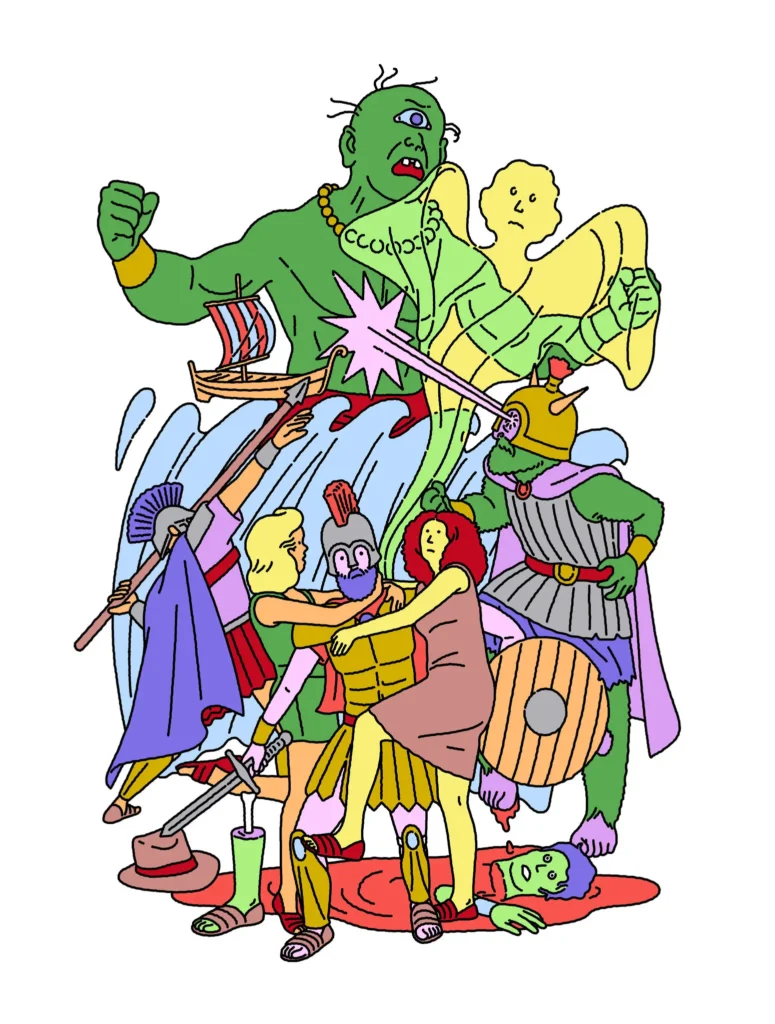
The “Odyssey” is a sequel to the “Iliad,” an intense epic of combat, sacrifice, honor and betrayal set in the midst of the Trojan War. This poem is episodic, focused on individual derring-do rather than clashing armies. It’s more “Raiders of the Lost Ark” than “Saving Private Ryan,” as Odysseus outwits and outruns various threats, including an enraged Cyclops.
The blind thing in his doubled fury broke
a hilltop in his hands and heaved it after us.
Ahead of our black prow it struck and sank
whelmed in a spuming geyser, a giant wave
that washed the ship stern foremost back to shore.
I got the longest boathook out and stood
fending us off, with furious nods to all
to put their backs into a racing stroke —
row, row, or perish. So the long oars bent
kicking the foam sternward, making head
until we drew away, and twice as far.
(translated by Robert Fitzgerald)
No, I mean action with lots of blood and gore
Odysseus comes back to Ithaka intent on violence. The suitors who are defiling his house and bothering his wife — believing that she’s actually his widow — are marked for death. The climactic books of the poem show Odysseus and Telemachus preparing for slaughter and then carrying it out.
It’s possible that ancient codes of honor dictated such brutality, though it’s also worth remembering that the world depicted in the poem was already ancient to the rhapsodes, who may have relished shocking their listeners with tales of the wild old days. In any case, Homer understood what filmmakers and comic book artists have always known about the appeal of graphic mayhem.
But Odysseus aimed and shot Antinous square in the throat
and the point went stabbing clear through the soft neck and out —
and off to the side he pitched, the cup dropped from his grasp
as the shaft sank home, and the man’s life-blood came spurting
out his nostrils —
thick red jets —
a sudden thrust of his foot —
he kicked away the table —
food showered across the floor,
the bread and meats soaked in a swirl of bloody filth.
(translated by Robert Fagles)
What about sex? Spicy romantasy is more my thing.
Odysseus spends a lot of the poem pining for Penelope. He also spends a lot of time in the company of other women, including two literal goddesses. The poem and its hero offer some excuses for this behavior — she put a spell on me! Really! — but mostly follow an age-old sexual double standard. He’s a complicated man. Boys will be boys. All of which brings the “Odyssey” sometimes into the neighborhood of historical romance and other times into a land of pure raunchy comedy.
In Book 6, our hero washes up on the shore of Phaeacia, where Princess Nausicaa comes to wash her laundry, attended by her handmaidens. The thing is, he’s not wearing any clothes.
“Now, girls,
wait at a distance here, so I can wash
my grimy back, and rub myself with oil —
it has been quite a while since I have done it.
Please let me wash in private. I am shy
of being naked with you — pretty girls
with lovely hair.”
(translated by Emily Wilson)
I’m more in the mood for an old-fashioned love story
When Odysseus reaches Ithaka, he has been away for 20 years. He arrives in disguise, partly to test Penelope’s fidelity but also to underscore that, after all this time, the two of them are strangers. Slowly, over the course of several books, interrupted by household intrigue of various kinds, they start to know each other again, in anticipation of a blissful reunion. They re-establish their sexual intimacy, and they also tell each other what has been happening during their long separation. The reunited couple fill a long night privately reciting their own versions of the poem we’ve been listening to.
When the two had taken their pleasure in love’s entrancing delights,
They took their delight in stories, each telling a tale to the other.
She, who glowed like a goddess, spoke of all she’d endured in these halls
Watching that gang of Suitors who wreaked so much hellish havoc
And who, on her account, slaughtered many a head of cattle
And fatted sheep, and drained so much wine from the huge storage jars;
While Odysseus, sprung from Zeus, spoke of the woes he’d inflicted
On people, and those he himself had endured with such great anguish.
He told it all, and she took delight in listening, nor did sleep
Drift upon her eyelids until he had told her everything.
(translated by Daniel Mendelsohn)
Ready to dive into the “Odyssey”? Here, in chronological order, are the translations cited in our story:
- Credits: The New York Times
- Author: A.O. Scott
- Illustration: Jim Stoten