
Lucas Sweeten says school buses saved his life.
In 2007, after serving in the U.S. military for six years with one tour in the Iraq war, Mr. Sweeten, 42, converted a school bus into a rolling home because he thought he was going to die. Nineteen years later, he works with public high school students in Louisville, Ky., to transform defunct school buses into mobile libraries, community centers and grocery stores that deliver to food deserts in the city.
“The process of working on buses is multidisciplinary and inspiring,” Mr. Sweeten said. “It’s more like creating usable art than traditional building. I wanted to share that inspiration with students.”
Over 20 years ago, when Mr. Sweeten was still in the military working as a combat firefighter, he began experiencing severe back pain that made it extremely painful to lie down. “I thought that maybe it was an artery that was going to explode, so I didn’t know how long I had left,” Mr. Sweeten said. “That’s when I decided that there’s no way I’m going live my life like this.”
So, he left the military and bought his first school bus on eBay for $2,500, seeking freedom and adventure. He considered buying an RV, but he didn’t like the price tag and didn’t trust the value. “RVs are often are only built to be used a few times a year, so simple pieces break, like water faucet handles, or knobs pull off, and metal parts get bent,” Mr. Sweeten said. “School buses are often overbuilt to provide safety to the passengers. So, they are reliable, safe and durable.”
He spent six months converting the 40-foot-by-8-foot vehicle into a home. At night, Mr. Sweeten slept propped up against a wall for three to four hours. During the day, he worked, installing a wood stove and an onboard water tank, and creating a living area and a bedroom.
“What I found out is that if I didn’t sleep much, I could deal with what felt like a hernia all the time and grunt through manual labor,” said Mr. Sweeten, who learned woodworking and masonry as a child growing up in Borden, Ind.
The bus pulled a trailer that served as a mobile garage where Mr. Sweeten converted the vehicle’s fuel consumption from diesel to vegetable oil. The trailer also held Mr. Sweeten’s hand-built hard-tailed 1974 Honda CB750 Chopper motorcycle, which he used to explore towns throughout the American West.
When he parked the bus in an alleyway in downtown Portland, Ore., Mr. Sweeten introduced himself to residents in the surrounding houses and asked them to come by. “Everybody expects, if you are ex-military and you live in a bus, that something has failed or you are Gary Busey from ‘Black Sheep,’” said Mr. Sweeten. “So, I would just introduce myself and then have them come by, and people were intrigued. It was an easy conversation starter.”
In 2008, while traveling in the Yukon, he met his wife, Lauren. In Alaska, he became a commercial fisherman.
A few years later, after he sold the bus to a couple in Sacramento. Mr. Sweeten swore off school buses. But after two months, he changed his mind.
“It was so much work to build,” Mr. Sweeten said. “But after I sold it, I really missed it. I missed having a home wherever I went.” So, in 2010, Mr. Sweeten bought a second school bus in Louisville for $4,500. Again, working alone, he gutted the vehicle with 115,000 miles on the odometer and transformed it into a home that met all of his needs.
Mr. Sweeten raised the vehicle’s roof and insulated the bus with closed-cell spray foam. He then installed 12V lighting and a 400-watt solar-powered energy system to power the bus’s refrigerator, lights, water pump and radio system. Using salvaged wood, Mr. Sweeten built the bus’s interior, which houses a propane stove, a wood stove, a stainless-steel sink with running water and wood cabinets and countertops.

He put a 100-gallon water tank underneath a bed. In addition to a concrete shower, Mr. Sweeten designed and built a composting toilet system and a counter-weighted, roll-down king-size bed using recycled parts from an installation company. On the rear of the bus, Mr. Sweeten constructed a hydraulic wheelchair lift to store his motorcycle. The total cost was $12,500.
In 2015, Mr. Sweeten drove the bus to Maine, where an MRI revealed that a tumor in his spine was the source of his back pain. He drove back to Indiana in 2016 and recovered in the bus, which he parked in a remote wooded area up the street from where he grew up. Locals came by to look at the bus, and word got out that Mr. Sweeten had created something unusual and usable.
Building to Give Back
In 2016, a holistic body therapy company in Louisville called Tip It Forward hired Mr. Sweeten to build a bus they could use to operate as a mobile clinic to reach underserved communities. Mr. Sweeten helped convert a school bus the company had purchased into a space where patients could be treated during the day and workers could sleep at night. The result, Mr. Sweeten said is “a beautiful and functional piece of art.”
Mr. Sweeten enjoyed the experience so much that he reached out to the local school district in Louisville, about 18 miles from his home. He wanted to develop a bus program with schools to teach students about food production.
“I had a whole pitch about how to invest in the communities by starting with teaching kids how, why, where and when to grow a garden, on a bus which they would have ready access to,” said Mr. Sweeten. The pitch was rejected. “My takeaway was it was too outside the box for the schools, especially coming from a bearded combat vet.”
Then in 2023, a group of students at Waggener High School in east Louisville, Ky. reached out to Mr. Sweeten. They heard about bus conversion work from Matthew Kaufmann, co-founder of Justice Now, a Louisville-based organization that works with students to find solutions to systemic issues in their community.
They were members of the school’s Black Student Union (BSU), and they needed help turning a school bus into a mobile grocery store.
“One of our BSU members who has since graduated, noticed that every time he came to school in the morning, he would see kids with junk food, and he was like, ‘That’s not healthy,’” said Laura Motley, 39, a teacher at Waggener who also works as a BSU sponsor.

“He lived in the west end of Louisville, which is primarily a low-income area of the city. When we started researching, we realized that part of town had only two grocery stores to serve about 60,000 people. So, we started thinking of ways that we could give back.”
Initially, the 178 members of BSU wanted to create a grocery store, but quickly realized that it was too big an endeavor. After a few BSU meetings, the group, made up of Black, white, Asian, Hispanic and Middle Eastern students, decided to create a school bus that would deliver free, fresh foods to underserved areas in west Louisville.
Shirley’s Way, a local nonprofit, donated a school bus to BSU, and the group hired Mr. Sweeten to renovate it for $60,000. They called it Grub on Wheels.
Mr. Sweeten met with the students to review designs and determine what he could build.
“He really made them feel like they were part of the process,” Ms. Motley said.
So far, the BSU students have raised $40,000. Mr. Sweeten used part of that money to gut the bus and raise the roof. He will eventually insulate the bus and put in windows, walls, doors and a floor. “Not only must it hold groceries and be climate controlled, it also has refrigerator systems and a hand-washing station as well as storage,” Mr. Sweeten said.
“We want a lot of space inside the bus for shelving and a water supply sink,” said Anjolaoluwa “David” Lyun, a senior at Waggener and president of BSU.
The BSU students also want to install solar panels and generators. They are currently trying to raise the remaining $20,000 to complete the bus by summer, when they plan to take Grub on Wheels on the road.
Across the city at Southern High School, students in the Justice Now club worked with Mr. Sweeten last year to create a multipurpose school bus.
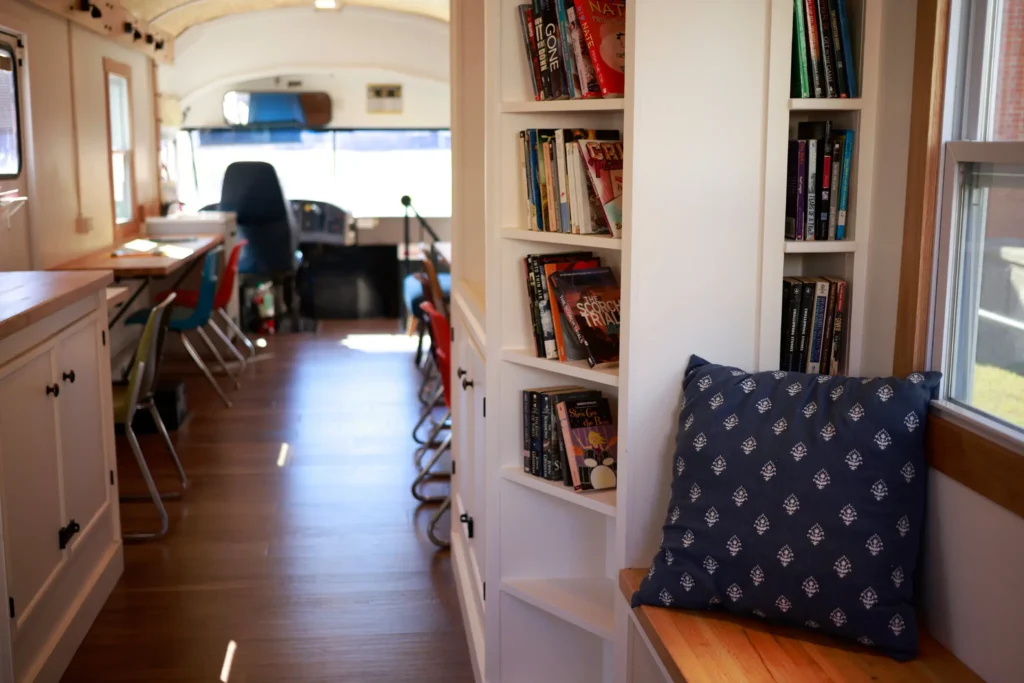
Shirley’s Way provided the club with the $60,000 needed to complete the bus, and Mr. Sweeten donated $5,330 of his own money to finish the project. In addition to a library, the bus is a space where Justice Now students will host events, hold blood drives and lead workshops with elementary school students. The 12-member club has also used the bus for food and clothing drives.
“My parents immigrated from Nepal to Denver when I was 9 months old,” said Regen Dulal, 16, adding that they didn’t have a lot. “Now that I’m in a position to give back to the community, I want to. I remember how much I appreciated it when new clothes or toys were donated to me.”
In December, Justice Now students used the bus to transport clothing and other items for a drive that served elementary schools. They’re now raising funds to have an artist paint a mural on it.
“Working with the kids is everything,” said Mr. Sweeten. “They see a problem, and they have an answer for it. They aren’t asking for someone else to fix it.”
“I think it’s good for kids to see what can happen when you think outside the box,” he added.
- Credit: The New York Times
- Author: Addie Morfoot
- Visuals: Luke Sharrett