

When a group of astronomers set out two years ago to map parts of the ancient cosmos, they had hoped to find galaxies that contained two black holes. The universe did them one better: They found a galaxy with three.
It’s the first time scientists have found evidence of a young galaxy that hosts a trio of active supermassive black holes, according to a paper published on Wednesday in the journal Astronomy & Astrophysics. Two of them are so close together that they appear to be on the verge of merging.
Virtually all the massive galaxies astronomers have studied have black holes at their centers, said Hannah Ubler of the Max Planck Institute for Extraterrestrial Physics and the lead author. Some pairs and triplets have been observed in nearby galaxies, but never a triplet so far from Earth. Their distance, which is more than 12.5 billion light-years away, dates them to within roughly one billion years of the Big Bang.
The snapshot of two black holes before they combine provides evidence that black holes have been growing, consuming stars and gases and shaping galaxies since the universe began. “The assumption has always been that these black holes started to grow in the early universe,” Dr. Ubler said. Now we are seeing them in action.
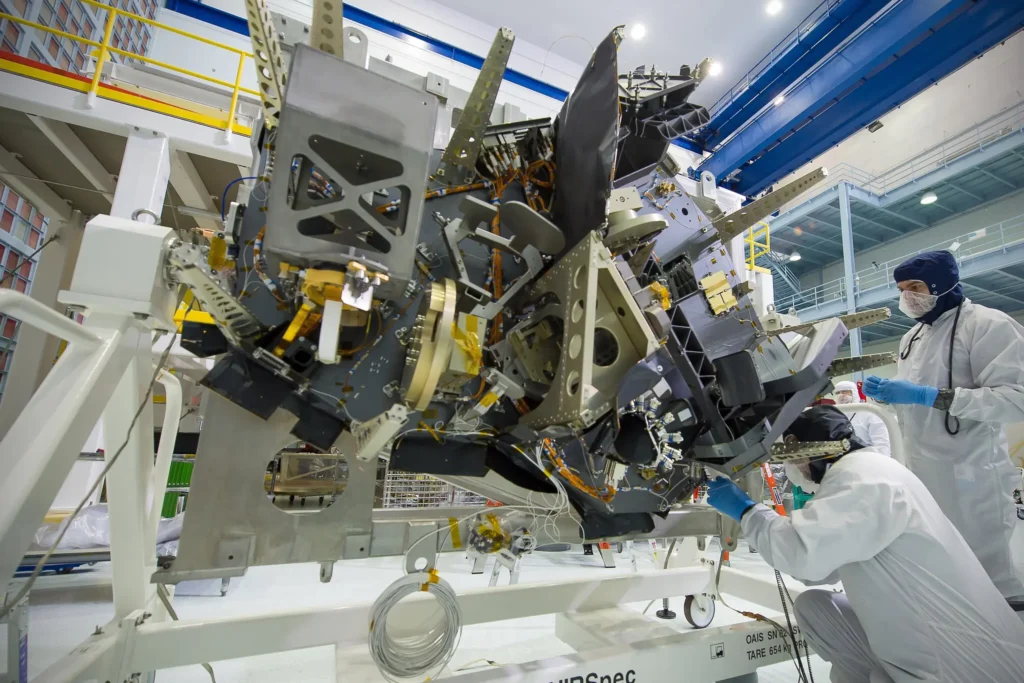
Such a discovery wasn’t possible until about four years ago, when the powerful James Webb Space Telescope began capturing images of cosmic light that has been traveling from the outer reaches of the universe for over 13 billion years.
Its predecessor, the Hubble Space Telescope, didn’t have Webb’s sensitivity or its ability to analyze light signals, said Steven Finkelstein, an astronomer at the University of Texas at Austin who was not involved in the research. At Hubble’s resolution, this galaxy would be just a few pixels in an image — too small to make out the contours of its three resident black holes.
To identify the trio, the researchers used what Dr. Finkelstein called “a really cool mode” of Webb’s powerful near-infrared spectrograph, which can tease apart the individual wavelengths of light hitting the instrument. That’s how they were able to visualize broad lines of hydrogen moving at thousands of kilometers per second. “The only thing in the universe we know of” that can make gases behave that way is the pull of a supermassive black hole that is still growing, he said.
The research team was then able to measure the distances between the three and determine that two are so close together that their gravitational forces must be pulling them into one another. As for the third, it’s possible it may join the merger in the future, or maybe it was ejected as a result of an even earlier merger, said Julie Comerford, an astrophysics professor at the University of Colorado Boulder who was not part of the study.
How black holes get so big is “one of the outstanding questions in astrophysics,” Dr. Finkelstein said. Scientists understand how smaller black holes form: When a star dies, it can explode and then collapse to create a black hole that is several times the mass of the sun. But those are tiny compared with supermassive black holes — like the one at the center of our galaxy, the Milky Way — equivalent to millions or billions of solar masses.
The smallest of the black holes Dr. Ubler’s team discovered is the mass of 600 thousand suns — the largest, 80 million. And the Webb telescope is turning up many others — far more than experts expected to find in the early universe.
There are several theories as to “how these extremely large and heavy objects could have been formed in such a short time,” said Giovanni Mazzolari, a postdoctoral researcher at Max Planck and a co-author on the study.
Maybe some are born extremely heavy. Perhaps they consume matter at astonishing speeds, growing as they feed on gasses and stars around them. And maybe, as the new findings suggest, it’s actually quite common for two giant black holes to dance around each other, collide and combine into one.
That may well be what’s about to happen here in 700 million years or so, by Dr. Ubler’s calculations.
- Credits: The New York Times
- Author: Amanda Schupak
- Photo: Chris Gunn/NASA