
Welcome home, Reid, Victor, Christina and Jeremy. You returned humanity to the moon, and now you’re back safely on Earth.
The four astronauts aboard Artemis II splashed down at 8:07 p.m. Eastern time in the Pacific Ocean near San Diego on Friday, concluding their historic 10-day mission, the first to send humans around the moon in more than 50 years.
“What a journey,” Reid Wiseman, the Artemis II commander, said to mission control. “We are stable one. Four green crew members.” Rob Navias, the NASA commentator during the re-entry, explained that “green” meant the astronauts were in good health and was not a description of their complexions.
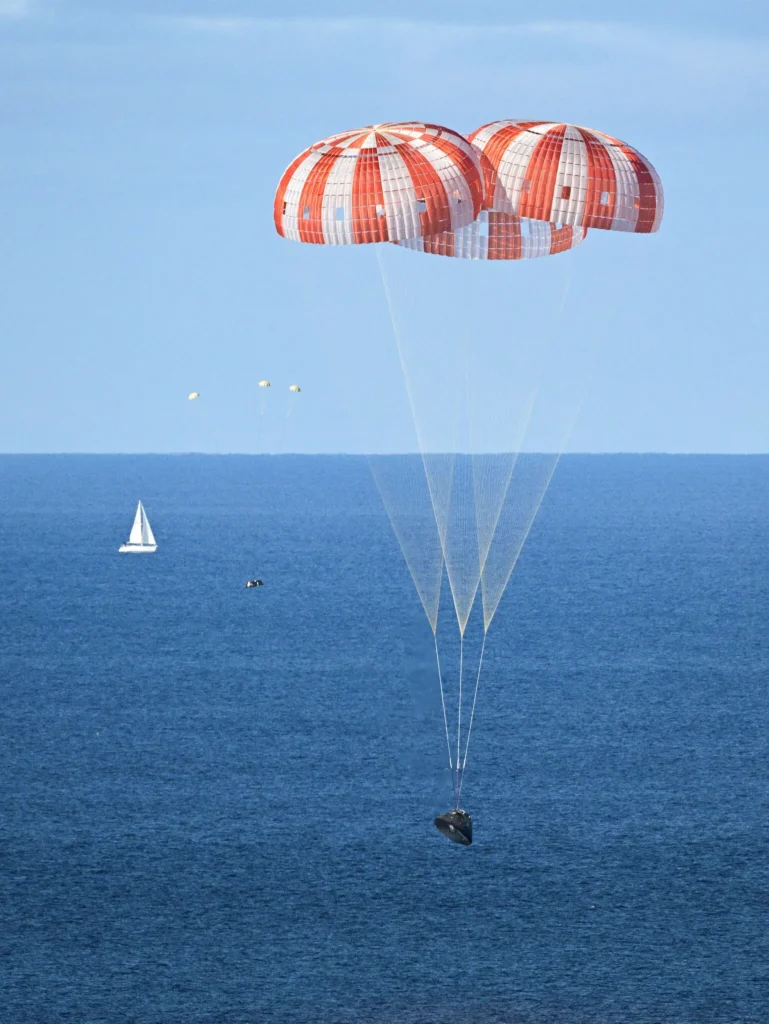
“Stable one” referred to the capsule’s upright position in the water.
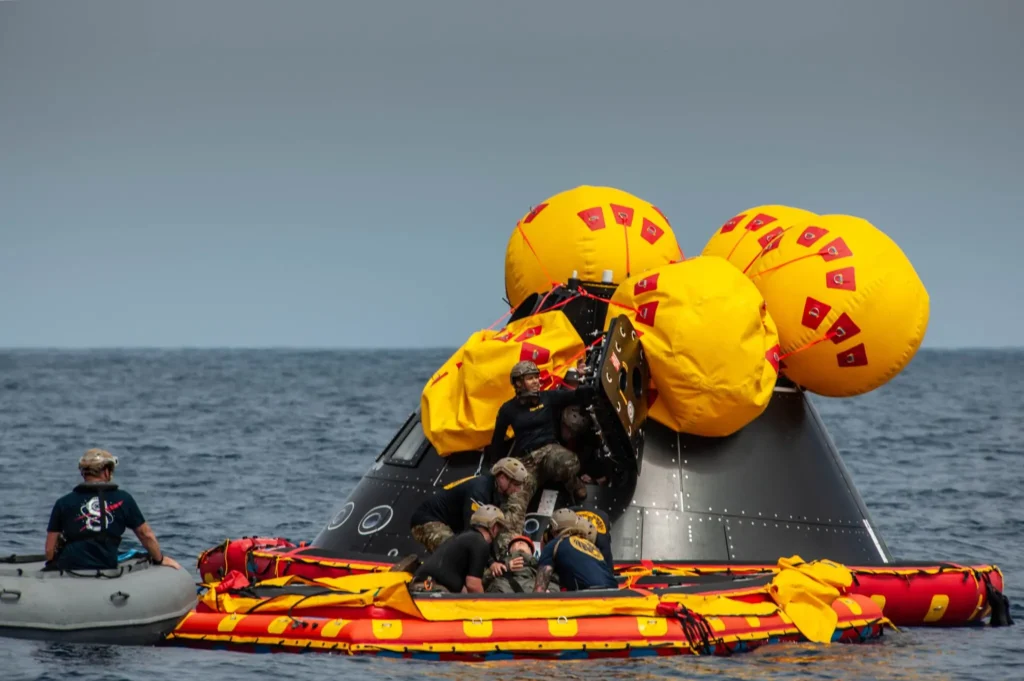
By 10 p.m., all four astronauts had been lifted by helicopters to the U.S.S. John P. Murtha after recovery crews had helped them exit the Orion spacecraft. The four astronauts all were able to walk unassisted across the Murtha’s flight deck to medical checks.
The mission has been filled with firsts. Victor Glover is the first Black man to travel around the moon, and Christina Koch is the first woman. Jeremy Hansen is the first Canadian astronaut to make the journey.
Commanded by Mr. Wiseman, the NASA mission surpassed the distance record set by Apollo 13 in 1970. As the astronauts swung around the moon’s far side, they passed through a point 252,756 miles from Earth, roughly 4,100 miles farther than the Apollo 13 crew had traveled.
In the process, the Artemis II astronauts studied parts of the far side that human eyes had never seen. (Those parts of the surface were in shadow during the Apollo missions.) They also witnessed a 53-minute solar eclipse, which wowed both them and people on Earth.
Artemis II has had its setbacks, including communications glitches and problems with a toilet, which showed a need for I.T. support and plumbing skills in space.
But most importantly, the mission demonstrated that critical systems on the Orion spacecraft, like life support and propulsion, can handle transporting human beings to the moon.
Here’s what to know:
Crew recovery: A recovery team from NASA and the U.S. Navy helped the astronauts out of their capsule. The efforts were initially slowed by ocean currents. They were then flown to the U.S.S. John P. Murtha, an amphibious transport dock ship. From there, they will be taken to shore and will return to NASA’s Johnson Space Center in Houston on Saturday.
More updates: NASA is providing an update on the mission’s outcome at 10:30 p.m. at Johnson Space Center. You can watch it in the video player above, and New York Times journalists will provide updates and context about that event.
Key figures: The mission, from liftoff to splashdown, lasted 9 days 1 hour 32 minutes and 15 seconds. NASA rounds this up to 10 days. It flew 700,237 miles, round trip. As the spacecraft re-entered the atmosphere, it reached its maximum speed of 24,664 miles per hour, just short of the crewed speed record set by Apollo 10, which recorded a peak speed of 24,791 miles per hour in 1969.
Lori Glaze said a lot of data has been gathered about the Orion capsule’s heat shield, which had known flaws. Aircraft watched the re-entry and divers examined it below the water after splashdown. Howard Hu, the Orion program manager, added that heat shield specialists are on the recovery ship to study the shield.
The Artemis II astronauts will return to Houston on Saturday, said Lori Glaze.
- Credits: The New York Times
- Author: Kenneth Chang
- Photo: NASA