

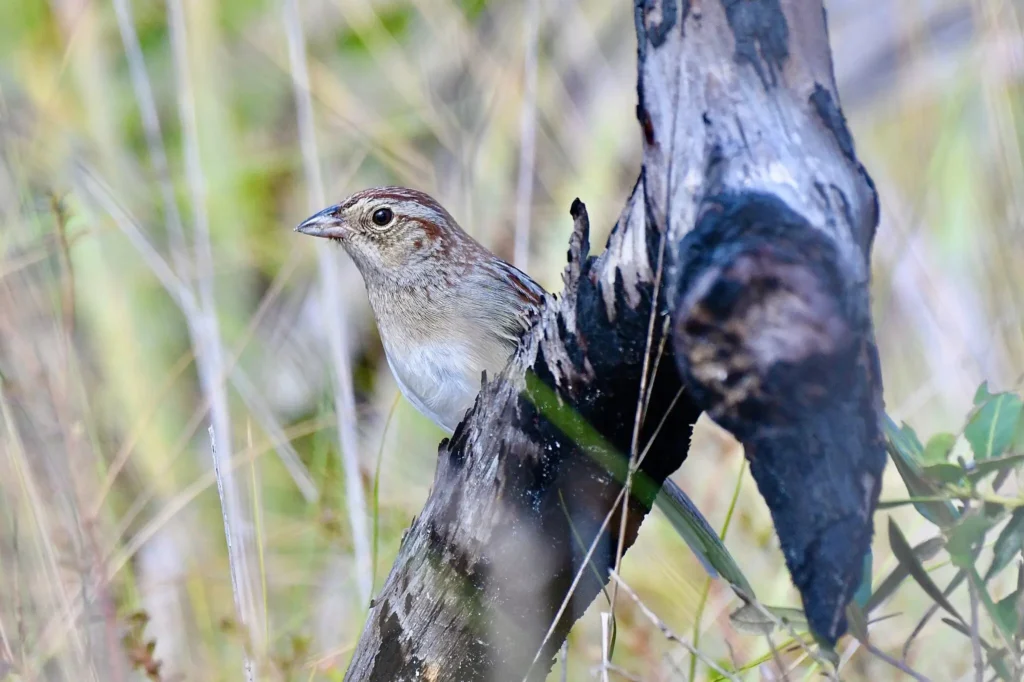
In the flatwoods of South Florida, tiny brown birds emerge from the underbrush to sing from the branches of pine trees. To human ears, their songs sound nearly identical, but any given population of these birds — Bachman’s sparrows — uses as many as 120 different song types to communicate.
Like human language, birdsong is dynamic. Every avian generation makes choices about which songs to continue singing, which to improve upon and which to drop altogether. A single Bachman’s sparrow might learn only 48 of the songs used by its community, and for decades researchers have been trying to figure out how baby sparrows choose which songs to adopt.
Previous studies have focused on social and cultural factors. During their critical song-learning phase of development, young songbirds imitate the adult males in their group who are successful in courtship or have elaborately ornamented plumage.
Now, a new study of Bachman’s sparrows reveals another possible part of the equation: the physical environment. Trees, dense shrubs and even wind can scatter or block the transmission of some sound waves, and researchers suspect that young sparrows are less likely to latch onto degraded songs, leading in turn to some songs becoming rarer than others.
“The rarer song types don’t propagate quite as well over distance than the common ones do,” said Rindy Anderson, a behavioral ecologist at Florida Atlantic University and an author of the study, which appeared on March 24 in the journal Bioacoustics.
All the Bachman’s sparrow song types have a similar form, with a buzzing or whistling note followed by a trill. Some trills are faster or slower than others, and some complex songs contain trills of several frequencies.
Researchers recorded a variety of rare and common sparrow songs and then rerecorded them playing in different environments — among dense trees, windy plains and other places that Bachman’s sparrows frequent but that could distort audio signals. Under these conditions, the researchers found that rarer songs did not propagate as well as common songs.
Earlier research with other songbirds has found that this sort of degradation can influence which songs birds choose to sing.
“The birds only learned the undegraded songs,” Dr. Anderson said of the previous research. “This is very interesting. This presents this idea of cultural evolution” driven by the environment.
The new finding and past research are in line with the acoustic adaptation hypothesis, which suggests that habitat and climate can shape the way animals vocalize. For instance, monkeys that bellow at low frequencies are more easily heard through the dense rainforest, and the shrill croaks of frogs cut through the sound of running water.
But some studies with other animals have yielded mixed results. For example, a recent study of 5,085 songbird species suggested that the main driver of song variation might be sexual selection. Even in the Bachman’s sparrow, acoustic clarity might not be the main factor determining which songs are passed on to the next generation. “It is one small piece of a big puzzle,” Dr. Anderson said. Social and cultural factors might play just as big a role, she added.
Still, the new result reveals another layer to the transmission of birdsong, and it could help to account for the ever-changing variety of birdsong in the world.
“On the one hand, for a song to be learned, it needs to be perceived, so it is only logical that songs that don’t transmit through the environment effectively should be more rarely learned,” said David Wheatcroft, an ornithologist at Stockholm University in Sweden who was not involved in the new study. “On the other hand, it is surprising to show this in the field, given that there must be so many variables other than degradation that influence song rarity.”
- Credits: The New York Times
- Author: K. R. Callaway
- Photo: Florida Atlantic University