

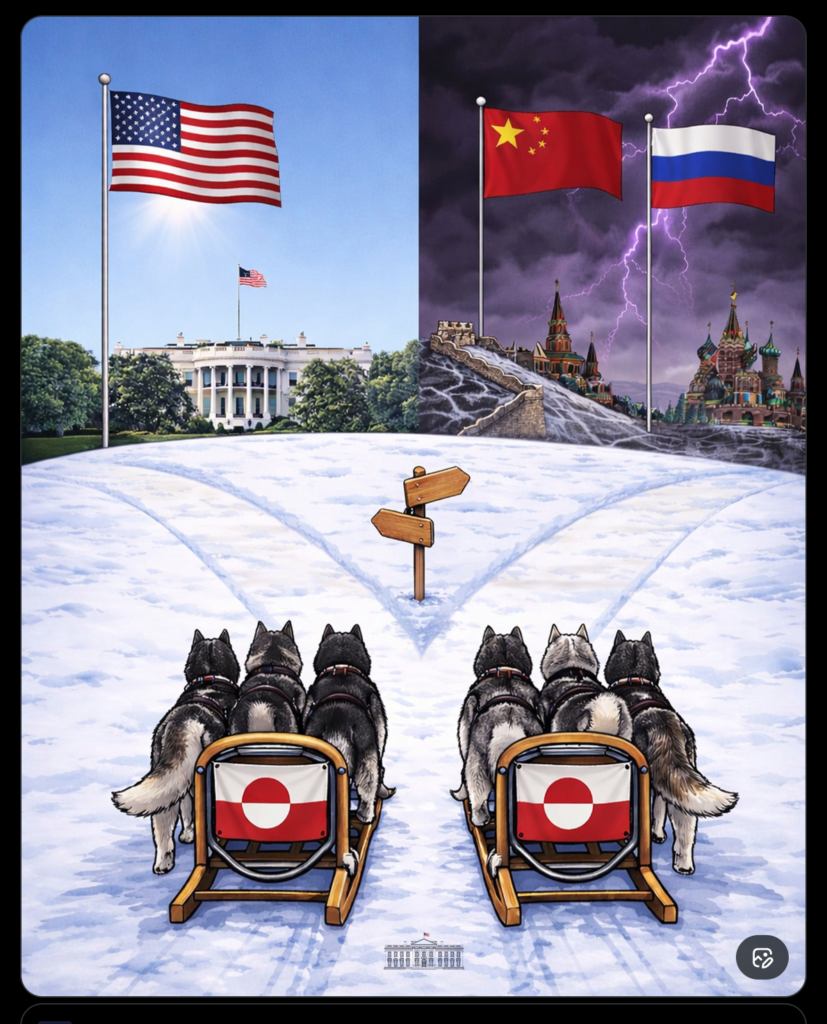
On Wednesday, the foreign ministers of Denmark and Greenland met behind closed doors with the American vice president and the secretary of state. Afterward, the Europeans described a “fundamental disagreement” over what the future of Greenland should be.
President Trump keeps insisting the United States should take over the island, and they’re not interested.
Lars Lokke Rasmussen, the Danish foreign minister, told reporters he hoped the three governments could lower the temperature on the debate.
“This is actually the very first time where we could sit down at a top political level to discuss it,” he said. He said he understood Trump’s view that Greenland’s future lies with America — or China or Russia. “We share, to some extent, his concerns,” he said. “There’s definitely a new security situation in the Arctic and the High North.”
That morning, the White House had posted a cartoon on X showing Greenland’s supposed paths.
Alongside it, Trump declared that anything less than U.S. control of Greenland was “unacceptable.”
The view from Nuuk
How does the saber-rattling play with the 57,000 people who live in Greenland?
Not well, report Jeffrey Gettleman and Maya Tekeli, who traveled to Nuuk, the capital, to find out. They discovered a kaleidoscope of feelings: shock, anger, confusion, humiliation, insult and, most of all, fear.
No one they spoke to wants Greenland to be recolonized, and very few have any interest in joining the United States. One told them she was well aware of the holes in this country’s health care system and its gaping economic inequality.
I talked to Jeffrey about that yesterday. He told me the people he spoke to hated the idea that officials thousands of miles away might decide their fate. And they are worried about changing the way they live:
People here enjoy a highly Scandinavian standard of living, which means free health care, free education and a strong safety net. At the same time, they value their traditions. I can’t tell you how many people we’ve met who still hunt seals and reindeer and love ice fishing and spending hours outside, with their sled dogs or on their snowmobiles.
Jeffrey had just talked to a Greenlander selling secondhand clothes and knickknacks on the street in Nuuk. “Trump really wants it, he keeps saying he wants it, and if he comes what are we going to do?” the guy told him.
Then he laughed. His name was Thue Norhsen. Jeffrey asked him if he wanted to become an American. “I like the way things are,” Norhsen said. “I don’t want to give that up.” Jeffrey said it was a refrain he had heard in Greenland over and over again.
A strategic hub
The Trump administration wants Greenland for a host of reasons, including its mineral resources, its size and its strategic location near Canada, Europe and even Russia via the Arctic Ocean.
Among other things, it’s a good place to keep track of Chinese and Russian naval ships crossing new routes through melted ice. (It’s also a good place, because it’s so close to the North Pole, to track missiles.)
NATO countries like the United States also use those routes and gather intelligence to counter Russia. Trump has repeatedly berated and coerced the organization, demanding that its member nations pay more for defense.
Now, his quest to take over Greenland, which as part of the Kingdom of Denmark is already under NATO’s protection, has raised concerns that he will shatter the alliance itself.
Trump said yesterday that NATO “should be leading the way for us to get” Greenland.
That view came with an implied threat: Without American military power, “NATO would not be an effective force or deterrent — Not even close!” he wrote on social media. “They know that, and so do I. NATO becomes far more formidable and effective with Greenland in the hands of the UNITED STATES.”
But what if Trump seizes the island by force? Then NATO has a different problem. Its founding treaty holds that an attack on one ally in the organization — in this case, Denmark — is an attack on all. An attack on all brings the obligation for each NATO member to respond, though not always with armed force.
In the nearly eight decades of the alliance, no NATO ally has ever attacked another.
- Credit: The New York Times
- Author: Sam Sifton