
Before I began writing about science as a journalist, I was a scientist. My work as a field biologist took me to some of the most extreme places — the waters off South Africa where I monitored shark populations, a remote island outpost off Mexico’s western coast where I cared for the chicks of seabirds nesting along the cliffs.
I always craved those assignments: pursuing science in isolating and difficult environments where the surroundings play a role almost as large as the research itself. Now, as a journalist, I’m seeking to document the research scientists are conducting in these remote locations.
So when I learned that this year marked a century since the first northern lights observatory in the world had ceased operating, something stirred in me. I wanted to understand the phenomenon that had compelled scientists to carve an observatory into a mountain peak above Alta, in northern Norway and high above the Arctic Circle, over a century ago. At the time it was built, in 1899, the observatory was accessible only by foot under perilous avalanche conditions.
I also wanted to document how that work was continuing today, under a new generation of scientists working in new, sophisticated facilities.
To do that, I teamed up with Michal Siarek, a Norway-based photojournalist, and together we set out to retrace more than a century of scientific studies of auroras.
Northern Norway is widely considered the birthplace of auroral science. In the 19th century, polar explorers trekked through the region to observe, measure and photograph the mysterious lights. The region sits within the auroral oval, where particles from the sun collide with Earth’s magnetic field to create the spectacular auroras that blaze across the Arctic sky.

I flew into Tromso, a city roughly 200 miles north of the Arctic Circle, and over the course of a week, Michal and I drove hundreds of miles northeast toward Alta. Along the way, we snowmobiled up mountains, snowshoed across valleys and ferried through fjords. We stayed in cabins, guesthouses, motels and hotels. Our plan was to visit four research facilities, old and new: the current observatories in and around Tromso, a newer radar midway to Alta, and finally the original observatory near Alta.
We arrived in mid-January, at the tail end of polar night, the monthslong period when the sun remains below the horizon. Michal is deeply familiar with Norway — he used to document lighthouse communities in the northernmost parts of the country — and his knowledge of the environment proved invaluable as we drove through the dark along icy roads. Tips like using birch bark, one of the best natural fire starters, helped us keep our wood stoves burning through the nights.
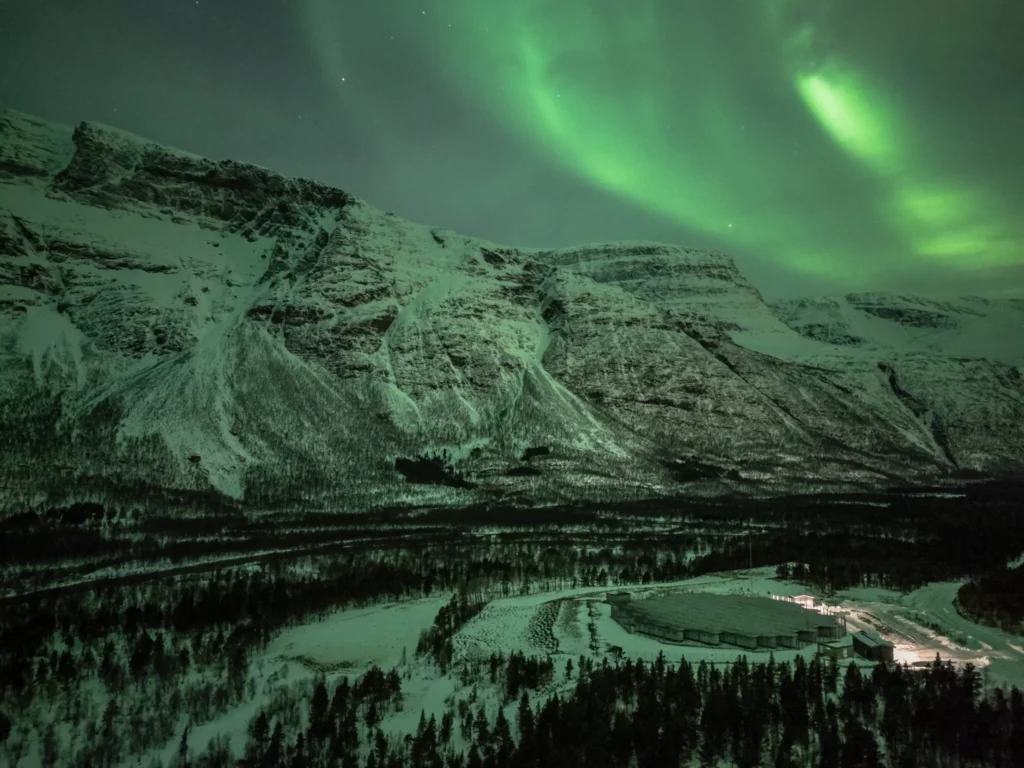
Our trip, in every sense, was dominated by the auroras. We saw them nearly every night. You can see auroras at any time after 6 p.m. or so, and they can go on for hours. They can intensify, die down, intensify again. At a research station outside Tromso, where we began our journey, the lights danced above us — like fingers raking across the sky — while Njal Gulbrandsen, a space physicist at the Tromso Geophysical Observatory, explained that the lights were tracing Earth’s magnetic field lines.
Through the frigid night, as we kept watch on the auroras, we warmed ourselves inside the station with black tea and chocolate. (At supermarkets along the way, we stopped to get our preferred assorted selection: milk-filled chocolate nubs, salty chocolate-covered cones and classic Norwegian milk chocolate.)

A few days in, as we pushed farther north, we got an alert from Dr. Gulbrandsen: “Interesting things going on at the sun at the moment.” We were staying at a guesthouse in Skjervoy, a small town tucked among the Arctic fjords between Tromso and Alta. That night, a rare and fast solar storm was sending spectacular streams of red and green auroras as far south as Germany. I braced against freezing winds to watch the same light displays that polar explorers must have witnessed as they crossed through this landscape more than a century before.
But the most striking moment of our reporting came when we finally reached the original observatory, near Alta. Built by Kristian Birkeland, a physicist and polar explorer, the original building was burned down during World War II and rebuilt in the 1980s for its historical value.
In temperatures hovering around minus 20 degrees Fahrenheit, we suited up and rode snowmobiles up Mount Halde. It took us a couple of hours traversing across snow-capped mountains to reach the observatory, which occupied a small stone building. Nearby were the residences where scientists and their families once lived while studying the northern lights in the early 20th century. The winds on Mount Halde are so strong, scientists told us, that children had to be tethered to a rope to keep from being swept away.
We experienced those gusts firsthand, along with a brief respite from polar night — when darkness lasts between 18 and 20 hours each day — as the sun crept above the horizon. By then, exhaustion had set in and we craved showers and sleep. Long nights, many of them with Michal out in the cold for hours, had taken their toll.
When night fell and darkness enveloped the observatory once again, an eerie green and violet aurora danced across the sky. After days of travel and frigid temperatures, we had reached the place where it had all begun. More than a century ago, scientists had stood on that same mountain, looked up at the same sky and tried to make sense of the same otherworldly lights.
- Credits: The New York Times
- Author: Alexa Robles-Gil
- Photo: Michał Siarek