
When Vita Shafiro, 51, and her daughter Mikhaela, 15, recently walked back to their downtown San Francisco hotel after sightseeing, an odd vehicle caught their eye.
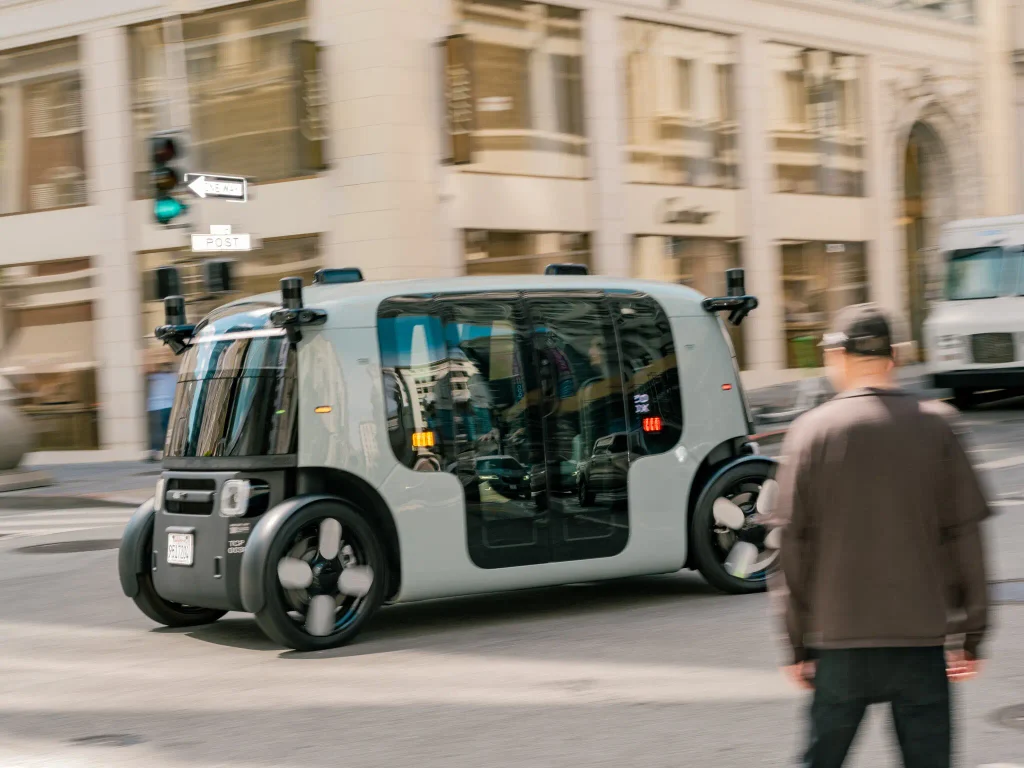
A boxy turquoise car with no driver’s seat or steering wheel idled outside the Zoox Rider Lounge, an Art Nouveau-style storefront. Zoox, a driverless car company owned by Amazon, opened the lounge in May so that people could pose for photos in front of its self-driving cars and take a free ride in one.
“I said, ‘Oh, look at that fun-looking vehicle,’ and I wanted to take a picture,” said Ms. Shafiro, who had heard of Waymo, the driverless car leader, but not Zoox. She and her daughter returned the next day and rode a Zoox to the Ferry Building, a landmark on the San Francisco waterfront.
“Surprisingly, I felt really good,” said Ms. Shafiro, who later took another Zoox ride to the Castro neighborhood, adding that she wanted to invest in the company.
The history of technology is full of rivalries — Amazon and eBay, Google and Yahoo, Uber and Lyft, OpenAI and Anthropic. Now a new matchup is taking shape in the nation’s tech capital between Zoox and Waymo, which kicked off the autonomous car industry and is owned by Google’s parent, Alphabet.
Waymo, founded in 2009 as Google’s experimental self-driving car project, is by far the leader in the field. It began commercial driverless rides in 2018 and now has nearly 4,000 vehicles in 15 cities, including San Francisco and Phoenix, with over a dozen more towns to come. Its brand is widely known, and it recently raised $16 billion in new funding.
In contrast, Zoox, which was founded in 2014, has about 100 autonomous vehicles in its fleet. It cannot yet charge for a ride in San Francisco as it awaits state regulatory approval.
So Zoox is competing by betting that novelty, community good will and the rider experience inside its odd-looking cars — sometimes called “toasters on wheels” — can win over a city that has become the center for autonomous vehicle experiments. While Waymo’s retrofitted vehicles are an ordinary sight in San Francisco, Zoox’s carriage-like pods with no driver controls still draw stares and phone cameras.
“From the beginning, we wanted to take a community-first approach,” said Carly Wyatt, Zoox’s vice president of communications and marketing.
Since May, the company has hosted more than half a dozen events at its Rider Lounge, including a recent happy hour where the women-focused brand Une Femme handed out free cans of wine. Zoox has also sponsored local festivals like the Stern Grove Festival, North Beach Festival and Flower Piano in Golden Gate Park. And it has become a sponsor of the San Francisco Museum of Modern Art, often bringing a vehicle to events so people can sit inside.
Zoox has also forged deals with social media influencers and introduced advertising campaigns with slogans like “a robotaxi from the future.” In June, it began offering free rides from its Rider Lounge to eight restaurants and a handful of San Francisco landmarks like the Painted Ladies, the postcard-perfect Victorian houses.
Ms. Wyatt said Zoox tried to operate like a small business “thinking of food, all the amazing restaurants, the areas that people know and love — and then how do we bring the Zoox experience to life.”
Unlike Waymo, which retrofitted cars, Zoox chose to build its driverless vehicles from the ground up at a plant in Hayward, Calif., without traditional controls like steering wheels and pedals. The company has leaned into the design, treating it as an edge over rivals, Ms. Wyatt said.
Zoox is working to begin widely deploying a commercial service. In July, federal regulators granted it a temporary exemption from certain safety standard requirements that include having windshield wipers and rearview mirrors, so it could place up to 5,000 vehicles on the road over the next two years and start collecting fares.
Last month, Zoox began charging for rides in Las Vegas, its first paid service anywhere, at prices that were slightly higher than standard rides with Uber and Lyft.
But to charge for rides in California, Zoox needs a deployment permit from the California Department of Motor Vehicles and authorization from the state’s Public Utilities Commission. Zoox said it had applied for a driverless deployment permit through the D.M.V., but the utilities commission’s public permit list does not show the company holding one.
“We are trying to get it as quickly as we can, but it is a couple-month process,” Ms. Wyatt said of the authorization. “We own the fact that we’re taking these baby steps.”
For now, Zoox offers only free demonstration rides in San Francisco, which began in November. The company completes about 10,000 rides a week in the United States, compared with Waymo’s more than 500,000 rides a week.
Waymo declined to comment.
San Francisco has seen driverless cars come and go before. Cruise, a subsidiary of General Motors, pulled its autonomous vehicles off the road in 2023 after a series of mishaps, including one car’s running over and dragging a pedestrian. Waymo has faced its own embarrassing episodes, such as when one of its cars hit and killed a beloved bodega cat last year.
Still, the autonomous vehicle race is heating up. Tesla said on Thursday that it would begin offering rides in its driverless Cybercab, which has no steering wheel. (The vehicle will probably not be broadly available for some time.) In London, driverless cars operated by Uber and the British autonomous vehicle start-up Wayve are available for ride-hailing this week.
Driverless cars remain in their infancy, which means the onus is less on companies to one-up their rivals than on spreading awareness of their services in the first place, said Jonah Berger, a marketing professor at the University of Pennsylvania’s Wharton School. Driverless car companies are still selling the very concept of a driverless taxi, he said.
“While one brand may be larger in the category and more prominent in the category, many people don’t know anything about the category,” he said.
Back in San Francisco, Carrie Blease — who with her husband runs Wolfsbane, a Michelin-starred restaurant — joined a partnership with Zoox in June. The company reached out to her through a hospitality agency to feature Wolfsbane as a destination for Zoox riders, she said.
Ms. Blease agreed to work with Zoox despite not being a “huge fan” of driverless cars, she said. Waymos are so common around her Russian Hill neighborhood that she often gets stuck behind one, she added.
Still, Zoox felt different and “a little bit more local,” she said, adding that “they look more interesting” than Waymos. Ms. Blease said she was excited when a few diners arrived at Wolfsbane via a Zoox last month.
Ms. Blease herself has never ridden in one. “I’ve just never done it,” she said. “I like the chatter of someone in the car.”
Credits: The New York Times
Author: By Emmy Martin
Photo: Kelsey McClellan