

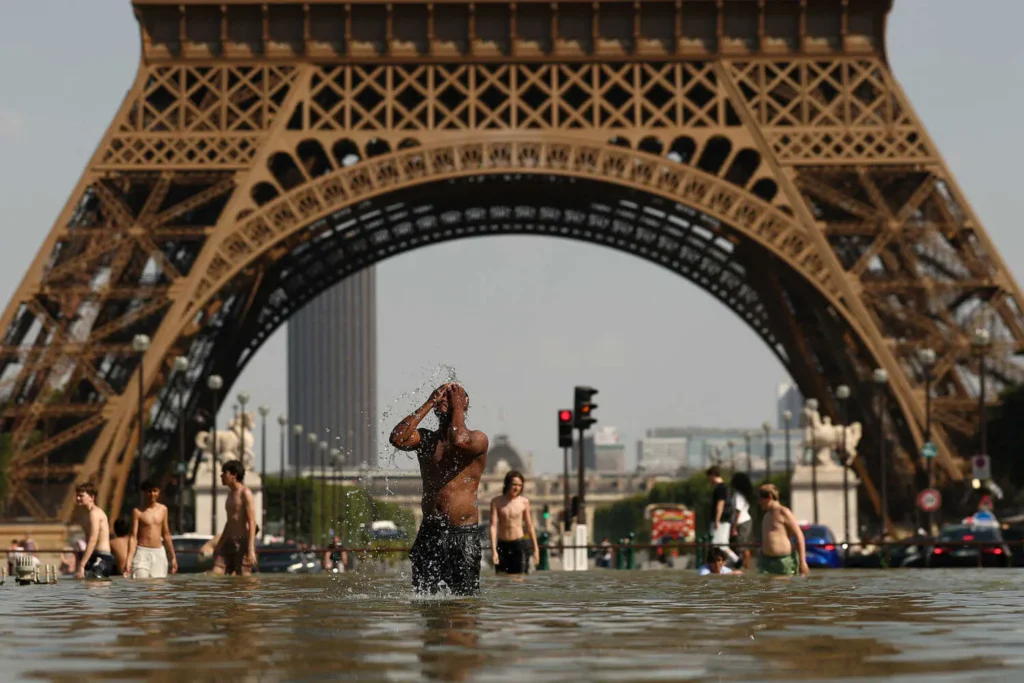
As Europe broiled under heat that is testing the continent’s ability to adapt to extreme weather, temperatures in Britain on Thursday broke records that were set just a day prior. In southwest England, temperatures of 36.4 degrees Celsius, or 97.5 Fahrenheit, were recorded in the early afternoon and were expected to rise.
The stifling heat wave — the second in two months — has disrupted education, transportation and other aspects of daily life for millions of people, with officials warning that older people or those who work outdoors, like on construction sites, are most vulnerable to the effects of extreme heat.
The heat has also proved deadly.
In Spain, where temperatures soared past 38 degrees Celsius, or 100 Fahrenheit, over several days, government statistical models suggest more than 200 deaths ultimately could be attributed to the heat wave. The institute cautioned that the figures were estimates but officials and experts say there is a clear correlation between extreme temperatures and serious health issues.
In Italy, five people have died from heat exposure this week, according to the country’s main news agency, ANSA. Several of the victims died while they were working outside, and a homeless man died in Naples, highlighting the vulnerability of those who had little choice but to be outside. In France, at least 40 people have drowned since the latest heat wave began in the middle of last week, many of them teenagers swimming in unsupervised areas.
Across much of Western Europe, temperatures remained in the high 30s to low 40s Celsius, or around 100 Fahrenheit, on Thursday afternoon. Paris reached 39.6 Celsius, or 103.3 Fahrenheit, and was forecast to reach 42 Celsius later in the day.
More than a dozen countries were under high-level heat warnings on Thursday, including Austria, Belgium, Britain, Croatia, France, Germany, the Netherlands, Serbia and Sweden.
Extreme weather events are becoming increasingly common and severe because of climate change driven by the burning of fossil fuels, experts say.
Europe is warming faster than any other continent, including in countries that are some of the least accustomed to extreme heat. In Britain and France, for instance, many buildings don’t just lack air conditioning — they are also designed to retain heat.
The heat is also testing infrastructure. At one point on Tuesday, nearly 120,000 homes lost electricity in France as the nation’s power grid struggled to meet demand, the national network, RTE, said. In southwest France, the authorities shut down a nuclear plant because the water temperature in the river, used to cool its reactor, was dangerously hot. Rail journeys in Britain, Germany and Switzerland were delayed or canceled as the heat risked buckling railway tracks.
Forecasters said temperatures were expected to gradually cool down across western Europe starting on Friday.
Globally, it was the second-hottest May in 177 years of record-keeping, after 2024, according to the National Oceanic and Atmospheric Administration.
Elsewhere, a city in Pakistan set a new heat record in May of 51.5 degrees Celsius, or 125 degrees Fahrenheit. Temperatures in some parts of northern India approached 50 degrees Celsius in May, forcing millions of workers to choose between falling sick and getting paid.
Here’s what else we’re covering:
Latest forecast: Temperatures in many parts of the continent are expected to stay high.
Staying cool: Hydration is key to avoiding feeling sick in extreme temperatures. Here are some ways to beat the heat.
“Blood rain”: Dust from the Sahara could add an apocalyptic hue to the unrelenting heat.
Offbeat air-conditioning: Belgium has offered some unconventional ideas to get a break from the scorching sun.
- Credits: The New York Times
- Authors: Lynsey Chutel, Nazaneen Ghaffar, Aurelien Breeden and Zane Irwin
- Photo: Gonzalo Fuentes/Reuters