
Venezuela’s most popular opposition leader, María Corina Machado, returned home on Sunday after nearly a year in exile, increasing pressure on the country’s authoritarian government — and its new chief authority, the United States — to move quickly toward a democratic transition.
At 11:31 a.m. Venezuela time, Ms. Machado wrote on X: “I am here. With you all.”
Ms. Machado entered Venezuela from neighboring Colombia, according to two government officials who asked not to be named to be able to discuss sensitive matters.
In the past, the Trump administration had made clear to Venezuela’s neighbors that it did not support Ms. Machado’s return, according to two U.S. officials, and her travel was blocked. But on this occasion U.S. officials decided not to intervene.
As critical U.S. midterm elections near, some voters in Florida have maintained that the United States is not pushing hard enough for democratic change in Venezuela.
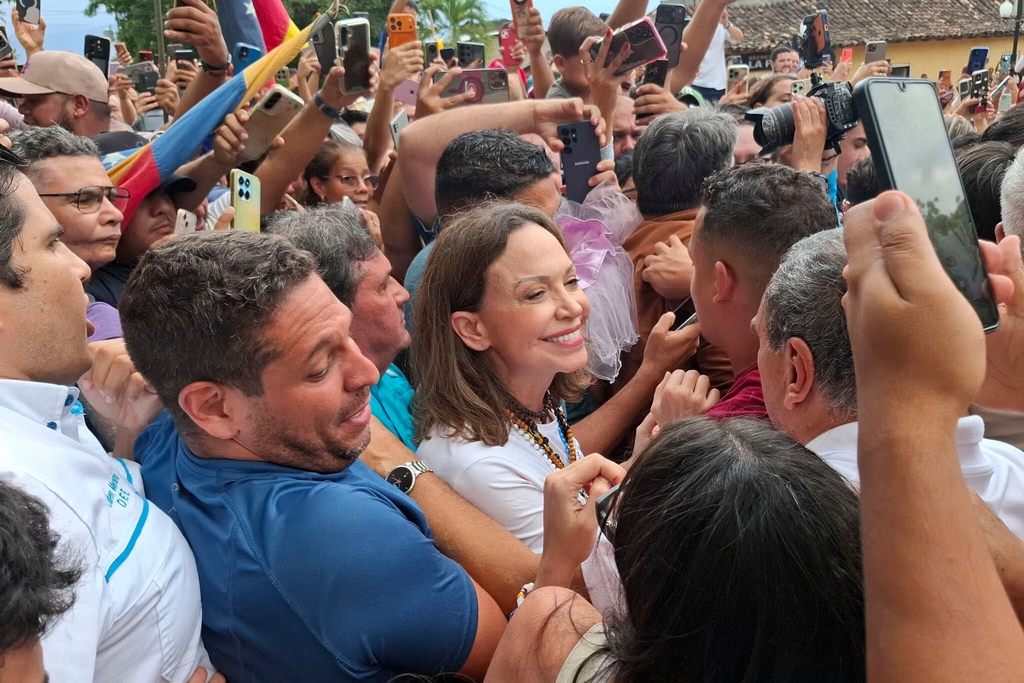
Shortly after Ms. Machado announced her arrival, her party posted images of her at a church in the state of Lara, in western Venezuela, where supporters embraced her.
Ms. Machado has called for elections in Venezuela by next July, and has expressed her interest in running for president. She would be an extremely competitive challenger to the interim leader, Delcy Rodríguez, who is part of the repressive government that has run the country for a generation.
Ms. Rodríguez is backed by the United States, which installed her as interim leader after the American military captured President Nicolás Maduro in January. President Trump has lauded Ms. Rodríguez repeatedly, but has said that Venezuela is not ready for elections as the United States works to extract oil and other natural resources from the country.
Ms. Rodríguez has said that Venezuela will have an election, but has declined to set a date. The United States, amid pressure from in and outside of the country, has orchestrated talks between Ms. Rodríguez’s government and a different part of the opposition, and the parties say they are working toward a vote. But the participants in those talks have not given a timeline for a democratic transition.
The Trump administration now considers the current moment to be acceptable, given the progress in a political dialogue in Venezuela, two U.S. officials said. They said that the United States had not helped Ms. Machado with her return on Sunday, but that it had not tried to block it.
Ms. Machado’s homecoming injects a level of uncertainty into Venezuela’s already fragile political atmosphere, and into the alliance between the Trump administration and the government of Ms. Rodríguez. The United States has struck major business deals with Venezuela, including an agreement on oil that Ms. Machado has criticized.
An aide to the opposition leader said Sunday that she was headed toward the capital, Caracas, after the church stop in Lara. In the past, Ms. Machado has commanded enormous audiences in the streets, even as supporters faced arrest.
Celebrations erupted in homes and public places around the country on Sunday.
“I feel very happy about this news,” said Coromoto Lugo, 43, a teacher. “It seems incredible, because we have wanted this for months. We have been waiting for better times, and I believe that now, a democracy built by Venezuelans is finally coming to Venezuela.”
Ms. Machado, a former member of Venezuela’s Legislature, has led the opposition for the past three years, spending much of that time living in hiding inside her country and trying to avoid arrest.
She fled last year when she was awarded a Nobel Peace Prize.
After the United States captured Mr. Maduro, the Trump administration chose to elevate Ms. Rodríguez to the presidency, despite Ms. Machado’s enormous popularity and longtime ties to Washington establishment figures. Tensions between the Trump administration and the opposition leader have been high ever since.
She said she had been trying to get back into the country, but has been blocked on at least seven occasions by authorities she has declined to name.
On Sunday, after she announced her return, Mr. Trump told reporters in Washington: “I don’t know anything about it, but I think she’s a very nice woman. She gave me her Nobel Prize, so how can I say anything else? And I hope she’s safe, she’s a very nice woman. But we’re doing really well in Venezuela.”
David Smolansky an aide to Ms. Machado, said in a statement that Ms. Machado’s return was “a major step toward a democratic transition and free, fair, and verifiable presidential elections in the near future.”
He said, “We thank President Donald Trump, Secretary of State Marco Rubio, the U.S. Government, Congress, and allied governments for their continued leadership and support.”
- Credits: The New York Times
- Author: Julie Turkewitz, Edward Wong and Adam Entous
- Photo: Jesus Hernandez/Associated Press