
The United States and Iran exchanged a barrage of strikes overnight, an outburst of violence that killed both military personnel and civilians in Iran, including four people at a wedding, according to Iranian news media and officials.
U.S. Central Command, which oversees the military’s operations in the Middle East, said that it had struck Iranian military targets in retaliation for attacks on ships and American forces in the region.
Four members of the aerospace division of the Islamic Revolutionary Guards Corps were killed in a U.S. strike in the western city of Kermanshah, according to a Guards statement published on Wednesday by Tasnim, an Iranian news agency. At least 12 people were killed in strikes across Iran’s southern region, the Iranian state outlet Press TV reported on Wednesday.
In response to the latest attacks, the Revolutionary Guards said in statements Wednesday morning that they had launched missiles overnight at an American military base in Jordan, at U.S. military equipment warehouses in Iraq and at an air base in Kuwait hosting American forces.
A U.S. official, speaking on condition of anonymity to discuss operations, said Wednesday all American service members were accounted for but declined to share any damage assessments.
The deadly back-and-forth overnight was a demonstration of the stalemate between Washington and Tehran, more than six months after President Trump launched strikes on Iran, saying that he expected a quick resolution.
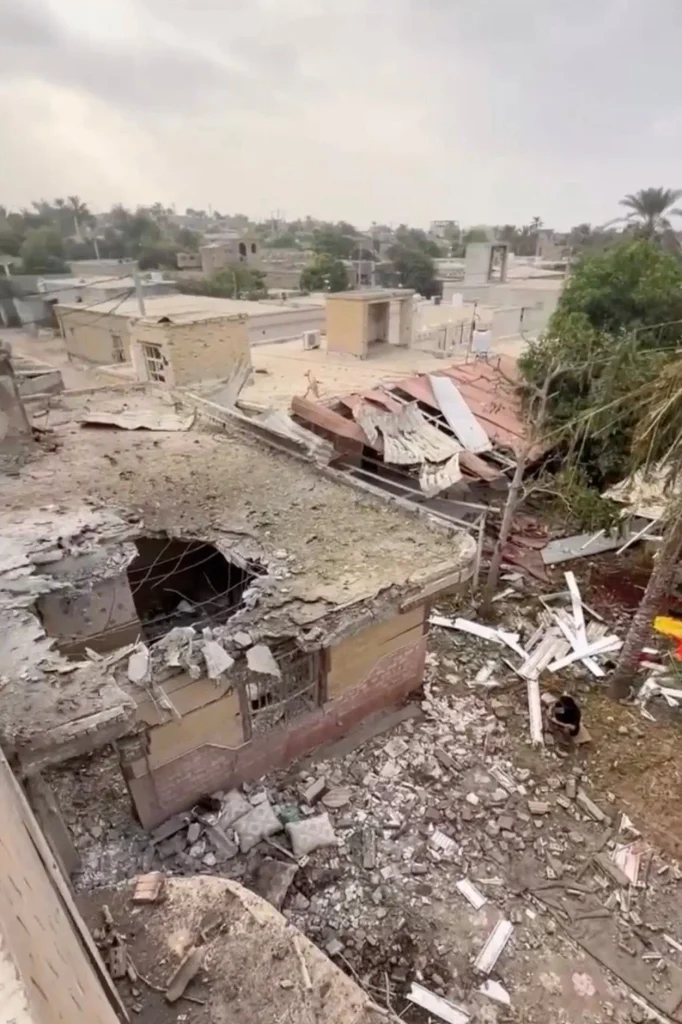
Among the locations hit by the U.S. military was a wedding in a residential area in the small port town of Kuhestak in the Hormozgan province of southern Iran, according to Iranian officials. Four people, including a child, were killed in the attack, with around 50 others wounded and hospitalized, Iranian state media reported.
U.S. Central Command said it was aware of the reports. “The U.S. military never targets civilians, unlike the I.R.G.C.,” the military said, referring to the Revolutionary Guards.
In a social media post on Wednesday, Esmaeil Baghaei, spokesman for Iran’s Foreign Ministry, condemned the strike and vowed that Tehran would respond “with firmness.”
The Jordanian military said on Wednesday that 13 ballistic missiles had entered the country’s airspace. Ten were intercepted and three others fell in remote, unpopulated areas, the military said on social media. Kuwait’s military said on Wednesday that its air defenses were confronting attacks by Iranian drones, and Bahrain’s military said that it had intercepted Iranian aerial attacks.
Later in the day, Mohsen Rezaei, a top Iranian security official, wrote on social media that Iran would soon unveil a “new strategy on the battlefield, in diplomacy, and in confronting the economic blockade,” referring to an ongoing U.S. naval blockade of Iran’s ports.
Iran has insisted that it should control the passage of ships through the Strait of Hormuz, which sits on its southern coast and, before the start of the U.S.-Israeli war, was a key waterway for the transit of oil and other critical resources. The U.S. Navy has been helping ships navigate a southern route through the strait, near the coast of Oman, drawing attacks from Iran.
In a statement, the Revolutionary Guards promised unspecified “additional punishments” for ships that took the U.S.-backed route. The Revolutionary Guards added that two oil tankers trying to transit the Strait of Hormuz had struck mines, exploded and were on fire. That claim could not be immediately verified.
The Saudi foreign ministry said Wednesday that Iran had targeted a Saudi tanker named Sidr passing through the Strait of Hormuz. Bahri, a Saudi shipping company that operates the tanker, said in a statement that two Filipino seafarers were killed during a “security incident” on Monday.
A diplomatic off-ramp does not appear to be immediately available, analysts say. Recent efforts by mediators to revive talks, including a visit by the Qatari prime minister to Iran last week, have not delivered a breakthrough.
“I think the diplomatic track has been stuck for weeks,” said Sanam Vakil, the director of the Middle East and North Africa program at Chatham House, a research organization in London. “The designated mediators are doing what they can and they’re still unable to make progress with both sides.”
Domestic divisions in both Iran and the United States, and a lack of clarity on where they stand on some issues, made a new escalation “only a matter of time,” Ms. Vakil said.
- Credits: The New York Times
- Author: Yeganeh Torbati
- Photo: Iranian Red Crescent Society, via Reuters