
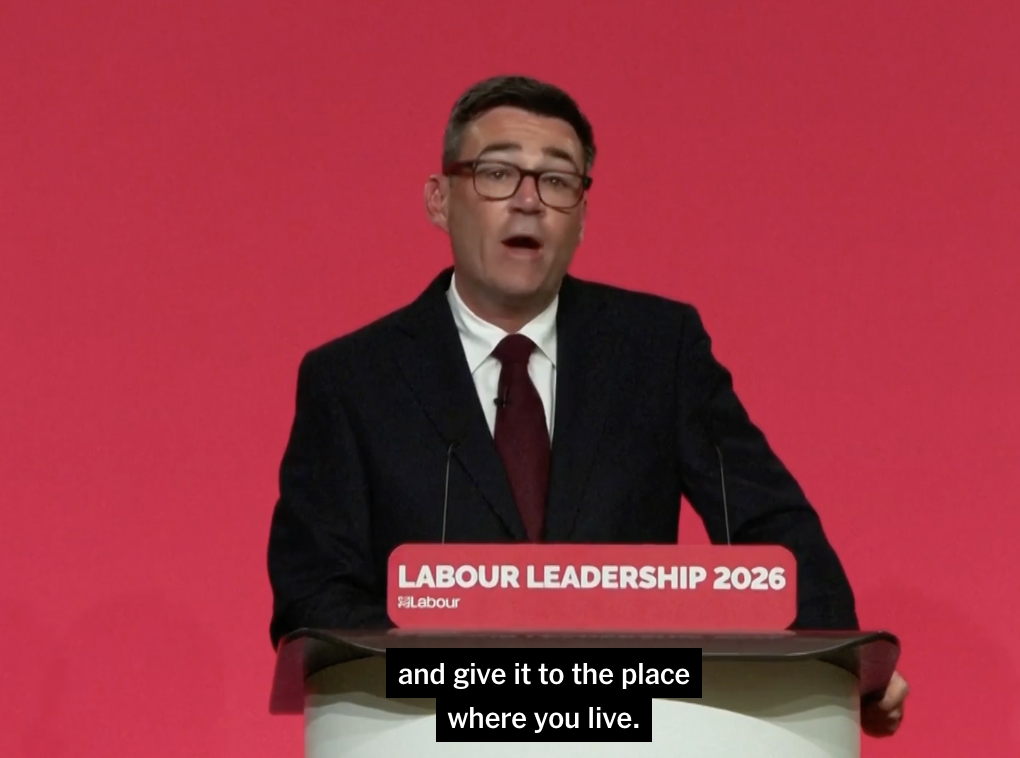
Andy Burnham was installed on Friday as the leader of Britain’s Labour Party, the final step before King Charles III asks him on Monday to form a government and become the country’s 59th prime minister.
In remarks to a special Labour Party conference in London, Mr. Burnham called for having “the courage to fix the big things that politics has neglected” and pledged to fix “an economic model that simply doesn’t work well enough for ordinary people.”
The former mayor of Greater Manchester faces many of the same structural problems that have caused the country to churn through prime ministers every few years since 2016: slow economic growth, high government debt, a struggling national health service and deep political divisions.
Mr. Burnham, who replaces outgoing Prime Minister Keir Starmer, spoke only vaguely in his speech about how he would confront those challenges. He talked about providing hope to people and said he would be a pro-business prime minister. At the same time, he said his government would be a “distinctively Labour” one and would seek to avoid the infighting that has often plagued the party.
As mayor of Greater Manchester, Mr. Burnham repeatedly argued that the national government was ignoring the needs of local communities outside London.
“Britain took a series of wrong turns in the 1980s,” he said Friday, referring to the transformative but contentious government of Prime Minister Margaret Thatcher, which oversaw extensive privatization and deregulation.
“The country surrendered control of the essentials — housing, water, energy, transport — and left people exposed to higher costs,” he said. “That, in turn, led to the concentration of more wealth and power in the hands of fewer people and fewer places.”
His criticism of past governments implicitly included his own Labour Party, as he said that “this generation of politicians, myself included, have failed” the people of Britain.
Here’s what else to know:
Road to No. 10: Mr. Burnham had ambitions of becoming a member of Parliament in his early 20s but grew disillusioned with politics in London. In nearly a decade as mayor of one of the biggest cities in England, he cultivated a plain-spoken, stand-up-for-the-little-guy Brand.
Search for growth: One of the earliest tests for Mr. Burnham as prime minister will be how to spark growth and revive the sluggish parts of the British economy. His stated plan — “Good growth in every British postcode” — is likely to be harder to achieve than it sounds.
Next steps: Mr. Burnham is now officially the leader of the Labour Party. But he won’t actually be prime minister for another few days. First Keir Starmer, the outgoing prime minister, has to go see King Charles III on Monday to officially resign. Then Mr. Burnham goes to see the king, who will request that he form a government. And then the work begins.
- Credits: The New York Times
- Author: Michael D. Shear