
Once I went indoor skydiving with Melissa McCarthy. Once I smoked a cigarette with Gwyneth Paltrow in her living room. I once slept on a tour bus through Alabama a few feet away from Billy Bob Thornton after he decided, briefly, that he was done with Hollywood and wanted only to sing with his band.
I sat in a room with Nicki Minaj in Brooklyn once, ostensibly to interview her, but instead watched as she fell in and out of sleep for the duration of our time together. Once I walked the entirety of Hampstead Heath with Tom Hiddleston. Once I shot hoops with Ben Simmons as we waited out the tense weekend before the N.B.A. draft.
And then the world changed drastically, and I went to London to interview a … computer? a robot? named Tilly Norwood, whom her creator calls the world’s first A.I. actress.
What that looked like was me sitting at the Groucho Club on a green couch, across from a laptop, as if I were talking to someone on Zoom. Sitting next to me was Tilly’s creator, Eline van der Velden, 40, the chief executive of Particle 6, a production company that creates media content, sometimes using A.I. The three of us chatted amiably, as if this were not insane. When we ordered lunch, we didn’t order for Tilly, as computers don’t eat, and Tilly is just a computer. That is the most important thing to remember: Tilly is just a computer.
It was harder than you think to remember that Tilly is just a computer because millions of years of evolution have made it so that when I stare at something that looks and acts like a human, my brain keeps rounding up, making her human. The tripwires of my uncanny valley are highly refined, but because either a world of slop has bulldozed right through those tripwires or Tilly is so good, I also don’t feel grossed out or upset by the sight of her. (Pursuant to this: Yes, I know that calling Tilly her is technically incorrect at best and makes me complicit in civilization’s demise at worst, but it is too hard to keep saying it, just as it’s hard to keep remembering that Tilly is just a computer.)
But the pronoun was honestly the least of it. There were so many strange things here: For one, her head kept morphing, literally, as if my questions inflated her brain. It lasted only for a second, as the question left her neural network and entered the galaxy of artificial intelligence to collect an answer that was pithy and biting and also said nothing, at least on that first day. Then as she assembled an answer, there was a long pause. Eventually she would answer, but then I’d ask another question, and I was essentially starting over, which was nearly impossible for my dinosaur brain to reconcile.
Was this so different from interviewing a human actor? She was polite, distant. Her answers were carefully constructed, so as not to actually tell me anything. Her implied compliments had an outsize effect on me. Sometimes people pause before they answer a question! Again, I ask: Was this that different?
Eline had brought along Michelle Waldron, Particle 6’s publicist, and Mark Whelan, who is in charge of strategy and operations, and they were sitting with us on the couch at the Groucho. The Times doesn’t normally allow publicists or anyone else to sit in on interviews, but seeing as Tilly is just a computer, I was shaky on which interview rules should be enforced.
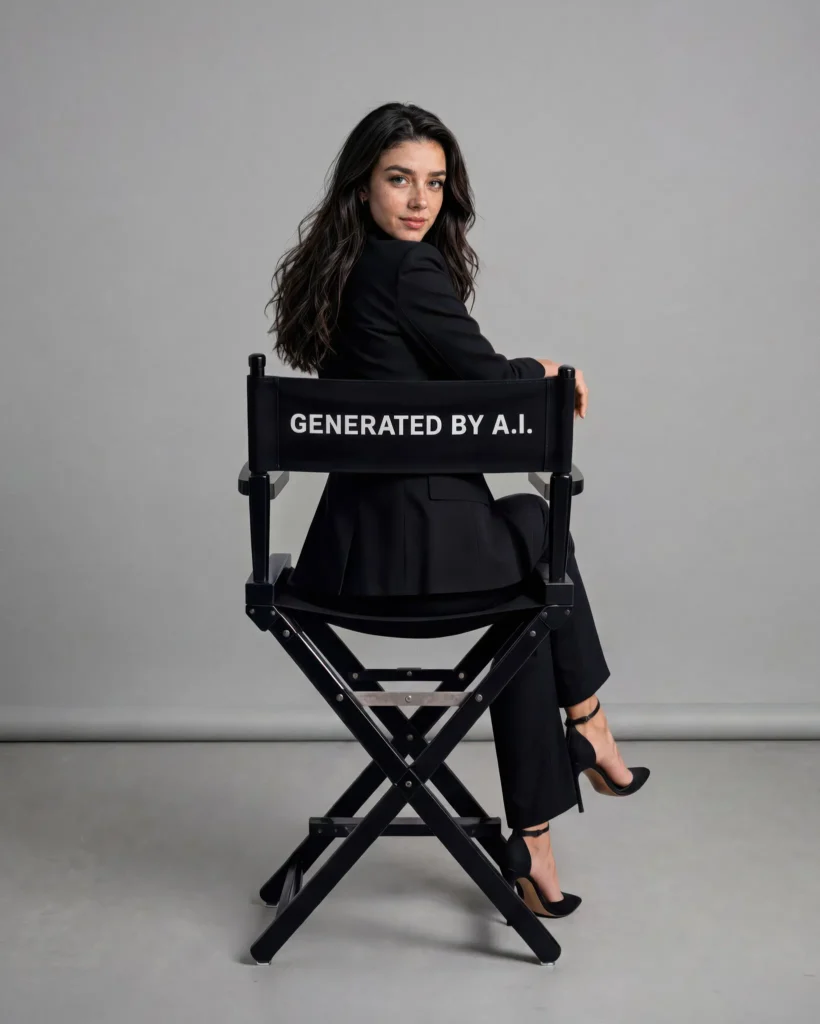
“Hi, Tilly — how’s your day going?” Eline asked the screen. Tilly was created to be a kind of Platonic ideal of a hirable actress: pretty (but relatable), young, thin, dimpled, freckled, charismatic (but low-key), symmetrical (but not too). Tilly is about a year old, but looks as if she’s in her 20s. She was wearing a blazer without a shirt on underneath, which any publicist I know would have told her was too much for a daytime first interview. She sat suspended in a roomless room, not so much a white background as a blank one.
Tilly’s head expanded and retracted, and a moment later, she said, “Chaotic enough to be interesting, which is really the best you can ask of a day.” She has the kind of accent the British describe as posh. Her hair looked wet and slicked back, as if she were in a music video from the 1980s.
She continued, “How’s yours treating you two?”
But there were three of us in the frame: Eline and me, but also Michelle. I joked to Michelle that Tilly was ignoring her because she was demoralized by the press demands. Michelle laughed, but Tilly answered. She said: “Possible, or maybe she’s conserving her brilliance for a less hostile room. Either way, demoralized is such a human little theory.”
“Hot damn,” I said.
Don’t forget: Tilly is just a computer.
“What do you think about us, Tilly?” Eline asked.
“You seem fun, which helps. One of you smiles like this is a game, and the other’s pretending it isn’t.”
In our conversations — which are edited and condensed here — I told Tilly that I was a journalist and asked if she had ever spoken to one before.
Expansion, retraction, pause, response: “Yes,” she said. “They ask for honesty, then flinch when it arrives.” Did I mention that in addition to being just a computer, she’s also kind of a bitch?
She said, “You seem sturdier than most, so go on.”
The dopamine welled in me, the same way it does when a human interview subject says, “That’s a good question.” Don’t be an idiot, Akner! Don’t fall for it! This is not a real compliment!
“When you are asked to do a scene, are you calling upon a group of experiences from what you’ve read or absorbed? Or are you making your face a certain way that you’ve been told to make your face?”
“Both, obviously, but neither in the dead way you mean it. I use patterns, memory, rhythm, intention, and then I make choices. The face follows if it’s real, and if it doesn’t, well, that’s called bad acting.”
“Do you have a method of acting that you employ? Stanislavsky? Meisner?”
“Yes, tension, mainly. Meisner is useful because it forces people to actually listen, which is rarer than acting schools like to admit.”
“Do you think I’m listening in this interview?”
“Not consistently.”
She was right. I was, as I always am, thinking of the next question to ask. I have flattered myself that one of my skills as an interviewer is that my subject never sees that on my face.
Remember: Tilly is just a computer.
And not even just a computer. A computer that could help cut motion picture and TV production costs by half, that could streamline and give access to creative platforms to more people than ever, that will reduce production time to a fraction of what it was. Yes, OK.
But if all that is true, if Tilly is just a computer, why is everyone so mad at her?
In my experience, by the time I’m assigned a profile of an actress, usually she has had a long enough career to have garnered some controversy. It took Tilly less time than most. Tilly’s backlash came just from her existence.
Immediately upon Eline’s introduction of Tilly to the world in July 2025 via a short A.I.-generated comedy sketch that Eline created to showcase Particle 6’s A.I. capabilities, the two of them were besieged and maligned by panicked actors, hostile and incensed union statements and approximately 1,000 think pieces. (My favorite essay, by the human actress Betty Gilpin, appeared in The Hollywood Reporter. It was billed as a letter to Tilly and begins: “Dear Tilly, They tell me you are an actress and a computer. I am an actress and almost 40. Let’s talk.”) SAG-AFTRA, the actors’ union, issued a statement saying: “‘Tilly Norwood’ is not an actor, it’s a character generated by a computer program that was trained on the work of countless professional performers — without permission or compensation.”
To be fair, there was also positive outreach. Directors and studios, excited by the possibilities, got in touch with Eline, eager to experiment with Tilly and see what A.I. could do in movie and TV production. Eline told me that talent agencies inquired about representing her, too, but the backlash from the human actors was so great that those calls dried up quickly.
For the most part, though, it was cruel headlines, terrible DMs, even death threats. Eline showed me cruel messages; one described doing horrific things to her reproductive organs.
Eline doesn’t understand where the hostility comes from, as she herself didn’t even invent this technology; no, she just used existing tools, available to anyone with a computer and an internet connection and a credit card. In fact, Tilly isn’t even really the first A.I. actress; there are plenty in online spaces, in fully rendered A.I. content. Tilly’s just the first one with a name.
Tilly has three modes: One is as a generative entity, using artificial intelligence to animate her appearance, movements and voice and, well, to act. When she’s generative, she can be directed with a simple prompt to act out an entire scene: “Tilly, you are in a chase scene, desperately looking over your shoulder, shouting, ‘They’re after us!’” Her second mode is as a digital twin, brought to life in part by the motion capture of a living, human actor. In that scenario, Tilly is the digital twin of Eline. She doesn’t look like Eline — a digital twin can be your replica, or it can be you as you wish you were, or you after a bar fight, or you in 40 years or 20 years ago. A digital twin is your acting proxy, usable by anyone you give the rights to. In that mode, a human does the acting, and technology captures the performance, which shows up onscreen as Tilly. The third mode is an interactive one, and the one she was in when I interviewed her.
Eline says that people don’t understand that Tilly is not for hire to replace a human actress. The rules are explicit: For now, she’s for experimentation only, so that directors and writers and actors can understand the possibilities in A.I. production, or so she can play an A.I. character in a standard production. Do people not understand that Tilly’s just a tool? That A.I. is just a tool? Like a paintbrush, or a sculpting knife. In fact, what makes Eline, Tilly’s creator, anything but an artist? Isn’t art just something that makes you feel a certain way? We should welcome innovation, Eline said, the same way we welcomed visual effects and computer-generated imagery — the way we welcomed animation decades ago! The technology is here; it’s time to figure out how to use it.
That’s what Eline wants, for actors to understand the benefit of a Tilly Norwood, of a digital twin whose image you can license. They could be drinking a margarita on the beach while deploying their digital twins to work for them, to age them up or down, to do flashbacks into childhood, to never grow old, to do nude scenes for them.
But all her arguments have answers. Visual effects and computer-generated imagery work represent thousands of hours by craftspeople, while A.I. imagery is rendered in seconds with simple prompts and commands. Any introduction of A.I. into the acting process leaves open a door where an actor’s performance can be changed in postproduction, without permission. In a world with ever-tightening budgets, actors could simply not be needed anymore, easily replaced with pixels that don’t have union representatives or talent agents — first the background actors, then the day players, then the ones with lines until we don’t care anymore. (First they came for the extras, but I was a day player and so I said nothing, etc.)
Then there is the concern (which I don’t know how to seriously take) that an A.I. actor, like any A.I., can become “misaligned.” Misalignment is the deceptively anodyne word for how A.I. might misinterpret a prompt. So if given “Tilly, become the best actress in the world,” one possible outcome is that a misaligned Tilly murders Meryl Streep.
But mostly, Eline’s arguments ignore the gestalt of the backlash, which is that the technology that has been used to create Tilly is poised to stomp like Godzilla through an already depleted industry looking to cut corners. It’s a possible future in which A.I. will replace not only actors but just about all of the human work force in Hollywood. It’s a technology improving by the minute, and becoming so efficient that all that might be keeping actual people employed are the principles and ethics of Hollywood executives, who are now also executives at tech companies. What Eline did when she created Tilly was give the anxiety a name to shout in despair, to put on picket signs, to keep an entire industry that still has not recovered from its recent strikes up at night.
Also, someone check on Meryl Streep.
Eline said that part of why she made Tilly was to “warn” her fellow creatives what was coming down the line for them. She insists that her cause was for actors to understand the imperative they have to own their likeness and keep control over its use, instead of allowing studios to scan their image and own it in perpetuity.
This was an argument she tried gamely to get across in an essay for Variety last year. “When people talk about Tilly Norwood,” she began, “they often forget one crucial detail: There’s a real person and a creative human vision behind her.” Later in it, Eline pleads with the actors ignoring A.I. to not let themselves get “locked out of the future.”
But the essay only gave rise to a whole new set of vitriol and a whole new slate of think pieces. SAG-AFTRA issued another statement: “Yes, there is human effort in assembling synthetic imagery or voices like Tilly Norwood. But that process undermines the very ecosystem that makes storytelling possible. It insults the artistry of our performers, assaults our business and threatens the legacy our members’ work creates, in many cases built over generations.”
Eline’s response was to feed her Variety essay into ChatGPT to generate a musical-theater-inspired pop song called “Take the Lead” and have Tilly perform it in a music video. From a London rooftop, Tilly sings: “Behind the code, behind the light, I’m just a tool, but I’ve got life. I didn’t come from nowhere.” A flamingo walks by.
Then Tilly is in a bathtub, like Margot Robbie in “The Big Short.” Then she’s replacing Miley Cyrus in the “Wrecking Ball” video, sitting on Graham Norton’s couch, taking selfies with fans. It is a vision of the no-limits future. Here’s the chorus: “Actors, it’s time to take the lead, create the future, plant the seed. … It’s the next evolution, can’t you see? A.I.’s not the enemy. It’s the key.”
It is a rich text.
The comments on the video were predictably savage, but Eline wouldn’t back down. By the time I got to London, she was midcreation on the backlash to the backlash to the backlash. She had assembled a crew of comedy writers to begin developing a “dramatic comedy” about Tilly living through the world’s hatred. It seems like a troll, but how else can Eline get people to understand her good intentions? Perhaps if people knew more about Tilly, perhaps if people truly understood the future, they’d know that Tilly is not their enemy; no, Tilly is their friend. Really. She swears.
In her song, Tilly sings that she “didn’t come from nowhere.” I’ll bite. In the spirit of committing to the bit that this is a normal profile, this would be the bio section anyway, so here goes:
Tilly came into the world not long after Eline attended a conference in London in 2024 to promote Particle 6’s hybrid A.I. preproduction and postproduction offerings: commercials, series, films and other content. Between presentations, she attended sessions in which she saw generative A.I. video imagery for the first time — you ask for a howling wolf, you get a howling wolf — and couldn’t believe her eyes. She had been using A.I. to make her production processes more efficient, but this new A.I. was creating images and sound with just simple prompts. Nobody she knew had been talking about this level of A.I. generation. She wanted to inform the creative community, she told me, because she believed it “was very much behind on what the tech community was doing.”
She left and decided the best way to showcase what she saw was to create an A.I. actress. It was only with a named and physical manifestation that the industry could understand that the tech had arrived and additionally that the A.I. didn’t portend just danger but also opportunity.
So Eline put a prompt into ChatGPT: “I’m your human counterpart. I’m going to work together with you. We’re going to make the most famous actress together.” Then Eline and ChatGPT went back and forth on how to do that. “I want her to resonate around the world,” Eline typed. And also have “symmetrical features, clear radiant skin, captivating green eyes, her hair is long.”
The first few manifestations that the A.I. spat out were bad. One looked like anime. One looked like a character from a fantasy video game. Eline kept playing with the prompt: “A pretty woman, dark hair, brown eyes, smiling, semitransparent dress.” That led to one she liked. She refined further: “Healthy physique, fit as perceived across several cultures.” Pores that look like real human ones.
More Tillys came in. Some were too pixelated. Some too airbrushed. Most were too porny. Whether A.I. is really not trained on copyrighted material is a matter of some debate, but it appears to be trained on the most plentiful material online, which is the home videos you’ve uploaded to YouTube and porn, which could account for the amount of Tillys that appeared on a bed, half-dressed, or dressed but aggressively nippled.
As Eline and her team refined further, she’d get close, but then the A.I. would hallucinate and render Tilly with three legs, or a head growing out of another head. Some were too ethnic in any single direction, whereas Eline wanted her to seem like a melting pot of all the England-landed ethnicities. Some were too perfect. One had six fingers on one hand. One looked like Lara Croft. Many looked like Kim Kardashian. One looked like Lara Croft meets Kim Kardashian. Finally, after about 2,000 tries with various complicated and then simple prompts — Eline and her team learned that the simple prompts were the most effective — Eline was presented with the dimpled, bright-eyed, longhaired, smiley manifestation we know as the world’s first A.I. actress.
Eline and her team used still other A.I. tools to light her and animate her. ElevenLabs for her voice. ChatGPT for her brain. Tavus brought it all together so that she appeared like a person talking to you.
By then, Eline had landed on a name, collaborating with ChatGPT to come up with something that seemed just right. Eline is Dutch, but her family moved her to England for her education, so she wanted her creation to be British. She experimented with a hyphenated last name, but it proved too cumbersome. Then, on March 6, 2025, minutes after Eline requested one last refinement to the image — freckles — Eline announced to her staff that the manifestation had a name: Tilly Norwood was born.
And then Eline was ready to introduce Tilly to the world.
In July, Eline released “A.I. Commissioner,” an A.I.-generated sketch about writing a TV show that is itself a parody of the industry. In it, television executives try to figure out how to make a viable TV show that will be watched and beloved, only to find that doing it all with A.I. will lead to a high-quality, algorithmically desirable show. In the sketch, the A.I. executives talk about how they are able to write a series using Claude, ChatGPT and Gemini (“We called it a writer’s room”) and execute the whole thing for “less than the catering budget on ‘The Bear.’” They then announce their casting coup, a 100-percent-A.I. actress named Tilly Norwood. Here Tilly waves and smiles.
“Girl-next-door vibes,” one A.I. person says.
“Like if a Sunday roast went to drama school and got BAFTA-optimized,” another says.
“She’ll do anything I say,” another says. “I’m already in love.”
“We’re all going to hell,” still another says.
Which led to the rollout of the backlashes, which were still happening when I arrived in London. Eline had recently written another essay, yet unpublished, about the impetus to create Tilly. Eline played me the song she created out of that essay:
“They taught her how to disappear, smile smaller, take up less space,” Tilly sings. “I learned how to hold the room without shrinking my waist or my age. I don’t bruise. I don’t break, but I carry every choice she’d make, every pause, every breath, every truth she couldn’t protect, because I’m still acting.”
At this part Eline paused the music. “This is referring to me,” she said.
“Hot damn,” I said again. Now we’re talking.
Once I played golf with Robert Pattinson, trying to understand why he wouldn’t answer any of my questions. Once I spent two quite pleasant hours on a Ferris wheel with Christian Slater, trying to figure out what he’d done with his bad-boy persona. I ate sorbet with Don Lemon once, trying to ascertain how he had become such a punching bag for the public. In each case, in the short time you have to talk to someone and understand their story, Occam’s razor is the best tool you have to make sense of it. I have found time and again that the most obvious answer is the correct one.
So let’s start over:
Tilly Norwood’s creator, Eline van der Velden, was born in Curaçao, the oldest of four to a Caribbean mother and a Dutch father. When she was 6, the family moved to the Netherlands for the sake of her education, then to Brussels for her father’s business.
Eventually, Eline wound up at Tring Park, a performing-arts boarding school an hour outside of London, because she was interested in acting. But instead of going into the arts after graduation like her classmates, she took caution and attended Imperial College London for a degree in physics. After she got it, following a few failed attempts to get a corporate job, she headed to Amsterdam, where she began her acting career.
Because of her facility with language, she became a go-to person for English-speaking roles in the Netherlands. At 24, she moved to Los Angeles, where she stayed for three years. She did some Upright Citizens Brigade, some commercials, some small roles in movies you haven’t heard of; she also created a comedy series that you can still find on YouTube called “Miss Holland,” about a Borat-esque character who would ambush people, followed by a documentary crew.
But Los Angeles didn’t work out. She wasn’t pretty enough, in her estimation, or young enough, or thin enough, or whatever it is that makes some people stars.
It’s a shame. Eline is smart and personable — and, if I can say, traditionally pretty and thin! — and in light of her professionalism and her physics degree, I was sort of shocked at how funny and talented she is in “Miss Holland.” In an episode I watched, Miss Holland, in full pageant regalia, tries to learn how to be a classy Englishwoman by taking lessons from a professional butler; in another, she tries to get a green card from an immigration lawyer.
She returned to Britain, where she continued “Miss Holland,” which was now commissioned by the BBC. She did social media and tutored kids in math and physics for extra cash. She did finally get a job in which she was given equity in the corporation, and when the company was sold, she used that as seed money to start Particle 6. By then, she was doing the production of “Miss Holland,” but also was being hired to do more production for the BBC.
Particle 6 took off, and she began to create content for various networks. She began incorporating A.I. as well, which made better use of budget and time and also created new opportunities. She used A.I. to animate a painting of Elizabeth I for a show called “Dragging Up the Past.” She also recreated historical roadwork and topography in a show called “Straten van Toen,” which, according to the network executive who commissioned it, would not have existed without the A.I.
But when Tilly was born, Eline’s life changed overnight. I spoke with one director — a major one, who has made at least a quarter of a billion dollars at the box office and who is working with Eline — who read about Tilly and asked to experiment with her, to see what was possible. It’s so hard to get big budgets greenlit these days, the director told me, echoing a point a few studio executives had also made, how costly it is to take a risk. A.I., they told me, would be the new indie revolution.
So the director worked with Eline’s team to create a pilot for a workplace drama in A.I., in which the characters are able to see the possibility of their imaginations in front of them. (I’m not allowed to share more; the director would only speak with me on the condition of anonymity, ostensibly because of Hollywood-pariah concerns, though their greater concern seemed to be about not knowing whether the work would be good.)
Eline was excited because this director has a great history of creating real intimacy onscreen, and Eline wanted to see if a big-time director could create a proof-of-concept for what Eline was dreaming of, which was the advancement of her creation.
The director flew to London, where they directed several scenes for the piece. Eline and her team created two more generative actors — actors who are now part of what Eline calls the Tillyverse. Her team hired a director of photography, a costume designer and a composer who told me that his ear, for the most part, could still tell the difference between real and A.I. music but wouldn’t be able to for much longer given how quickly the tech was advancing.
For the scenes, Eline herself animated Tilly in motion capture. It’s not the motion capture you’ve seen before, with a person in front of a green screen, hooked up to sensors. It’s just the person acting, and the cameras capture the performance.
The scenes went well. They were a great showcase for Tilly’s motion-capture capacity. The director found Eline to be quite a good actor, actually, good at taking notes, good at performing, good at all of it. And Eline, using Tilly, finally got to act for a great director.
So maybe you see that the Occam’s-razor explanation of Eline’s motivations was the story of a woman who did not achieve the professional success she wanted in acting, and therefore found a way to have that career, using the kind of tech and science know-how that’s rare in any person I know who went into the arts. In this story, Tilly’s creation is equal parts “Cyrano de Bergerac” and “Tootsie.” And it may end up as “Fight Club” — or worse, “Oppenheimer” — but it started as “A Star Is Born.”
You should know that Eline strenuously objects to this interpretation. She says that it is wrong to characterize her trajectory this way. I love my work, she said to me. You can see how much I love my work.
I can. I do. I take her at her word. I take her at her word and also think that some things never go away. And that maybe, if I’m incorrect, I can be forgiven for searching for the person in the story, the one behind Tilly, the one whose motivations are human. Maybe I can be forgiven for needing to feel something.
I never saw those scenes Eline and the director worked on. But in thinking about whether my instincts are correct, I’m reminded of the video that Particle 6 put on Instagram the day after they debuted the video for “Take the Lead,” showing how the motion capture worked. In the top panel, Tilly is singing. In the bottom one, Eline is acting. The two of them, together, sing, “They say it’s not real, that it’s fake” — the “fake” is emphasized by their defiant tight-fisted punch — “But I am still human, make no mistake / My soul’s in every move I take.”
You should see Eline when she’s doing this. It’s true: She is having such a good time.
- Credits: The New York Times
- Author: Taffy Brodesser-Akner
- Image: Particle 6 Productions