
New research has found that scientists studying sea-level rise have been using methods that underestimate how high the water already is. One result is that hundreds of millions more people worldwide are already living dangerously close to the rising ocean than Western scientists had previously estimated.
The new study, published Wednesday in the journal Nature, has found that the vast majority of scientific studies have made this mistake. Coastal sea levels are, on average, eight inches to a foot higher than many maps and models of the world’s coastlines indicate, the research found.
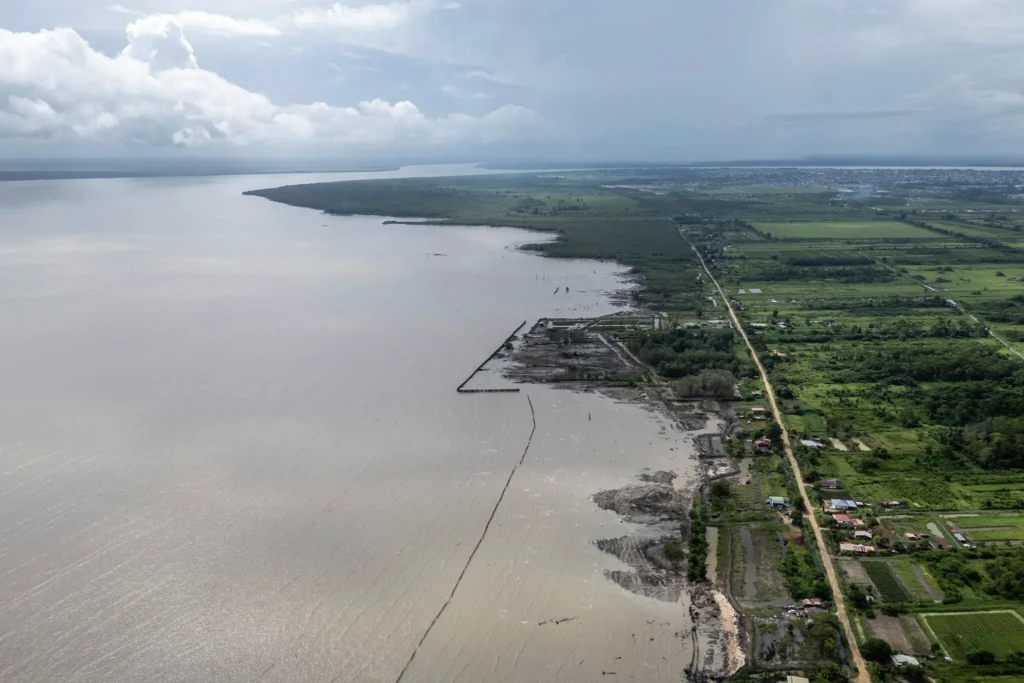
The discrepancies are much bigger in certain regions, like Southeast Asia and Pacific nations, where ocean dynamics are more complex. There, coastal sea levels are up to several meters higher than commonly estimated.
The new findings don’t mean that these studies are wrong in their broader conclusions about the rate of sea-level rise or the damage it might cause. Coastal sea levels are rising as the world warms. What the new findings mean is that scientists have often been working from the wrong starting point when calculating what land and populations might be affected in the future.
In the simplest of terms, they were underestimating where coastal sea levels already are.
That matters as governments and policymakers turn to science to understand how much land — and how many people — may be affected as the world warms and oceans rise, said Katharina Seeger, a postdoctoral researcher at the University of Padova, who led the study while working toward her Ph.D. at the University of Cologne. “I didn’t expect the discrepancy to be so immense,” she said.
It’s hard to imagine not being able to trust a map in an age where GPS and satellite imagery is so prevalent. But the new study has identified a far-reaching problem in the method that researchers often use to understand coastlines and how they might change in a warming climate.
The study checked 385 other peer-reviewed papers and found that less than 1 percent had correctly assessed where sea levels are today. The problem starts with a decades-old method that compares satellite-based measurements of land elevation to something scientists know as a “geoid model,” which is a technique for estimating average sea level based on Earth’s gravitational field.
This method was once considered “state-of-the-art” and commonly taught in graduate school, said Philip Minderhoud, the senior author of the paper and an associate professor who studies land subsidence and sea level rise at Wageningen University & Research and Deltares, a scientific institute in the Netherlands.
However, other satellites and instruments can measure real sea level and reveal local differences from factors like currents, winds and tides, which can also influence sea levels but are not included in the gravitational-field model. Scientists can most accurately estimate sea level when both pieces of the puzzle are combined correctly.
But largely, the new study found, that hasn’t been the case. Some 90 percent of the studies that Dr. Minderhoud and Ms. Seeger checked relied only on the method of mapping sea levels with Earth’s gravitational field. Another 9 percent of studies, most of which are relatively recent, did use both kinds of data, but seemingly failed to combine them correctly.
Robert Kopp, a climate and sea level scientist at Rutgers University who was not involved with the study, said the work addresses a technical issue that will matter far more to scientists than to decision makers at local levels. “In general, people who are exposed to high-tide flooding know where the ocean is,” Dr. Kopp said. Scientists have long said sea level rise will affect many people, and the new study doesn’t change that, he said.
However, from a global perspective, the findings indicate that hundreds of millions more people — particularly in Vietnam, the Philippines, Indonesia, the Maldives and other Southeast Asian and Pacific nations — are living closer to sea level than widely assumed by Western experts and policymakers.
It was 10 years ago, on the shores of the Mekong delta in Southern Vietnam, where Dr. Minderhoud said he first realized there may be a discrepancy. He was doing research on the delta’s sinking land, so he was familiar with maps of the region, and he noticed that the water looked “much higher” than it was supposed to be.
It was his first indication of a “widespread mismatch,” Dr. Minderhoud said, between scientific understanding and reality in the region, and ultimately led to the study published this week. He said the study shows that methods of studying sea level rise that seemed to work relatively well for coastlines in Europe or the U.S. led to bigger discrepancies in other parts of the world.
Torbjorn Tornqvist, a geology professor at Tulane University in Louisiana who was not involved with the study, said the findings were a real “wake up call,” with wide implications. “We finally have a really full blown, robust effort to sort this out and the result, it’s somewhat dramatic,” Dr. Tornqvist said. “It turns out we’ve been comparing apples to oranges nearly all the time.”
- Credits: The New York Times
- By Sachi Kitajima Mulkey and Mira Rojanasakul
- Photo: Juan Barreto