
Having an imaginary friend, playing house or daydreaming about the future were long considered uniquely human abilities. Now, scientists have conducted the first study indicating that apes have the ability to play pretend as well.
The findings, published Thursday in the journal Science, suggest that imagination is within the cognitive potential of an ape and can possibly be traced back to our common evolutionary ancestors.
“This is one of those things that we assume is distinct about our species,” said Christopher Krupenye, a cognitive scientist at Johns Hopkins University and an author of the study.
“This kind of finding really shows us that there’s much more richness to these animals’ minds than people give them credit for,” he said.
Researchers knew that apes were capable of certain kinds of imagination. If an ape watches someone hide food in a cup, it can imagine that the food is there despite not seeing it. Because that perception is the reality — the food is actually there — it requires the ape to sustain only one view of the world, the one that it knows to be true.
“This kind of work goes beyond it,” Dr. Krupenye said. “Because it suggests that they can, at the same time, consider multiple views of the world and really distinguish what’s real from what’s imaginary.”
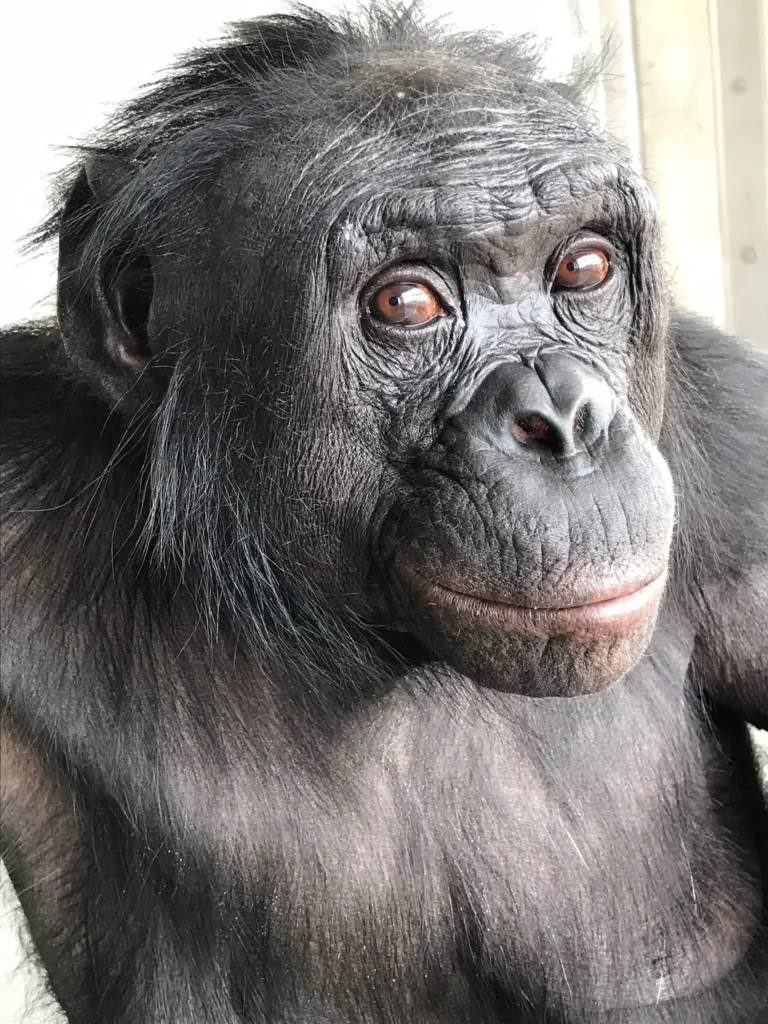
Bonobos, an endangered species found only in the Democratic Republic of Congo, are difficult to study in the wild. For this research, Dr. Krupenye and Amalia Bastos, a cognitive scientist at the University of St. Andrews, relied on an organization known as the Ape Initiative to study Kanzi, a male bonobo famous for demonstrating some understanding of spoken English. (Kanzi was an enculturated ape born in captivity; he died last year at age 44.)
The research team created three experimental scenarios for Kanzi that they compared to “tea parties.” The first was modeled after experiments conducted in the 1980s that involved make-believe play with children. As Kanzi watched, a scientist sat at a small table bearing two empty cups and an empty jug. The researcher then “poured” an imaginary juice into each cup, and then poured one of the cups back into the jug.
At that point, if Kanzi was closely tracking the imaginary fluids, he should realize that one cup still held liquid and the other was empty. And in fact, when asked — “Where’s the juice?” — Kanzi pointed to the cup containing imaginary liquid more often than would be expected by chance.
Still, scientists wondered, what if Kanzi was confused? In a second experiment, Kanzi was again presented with two cups: one with real juice and another into which imaginary juice was poured. Asked where the juice was, Kanzi pointed to the cup with actual juice, again more often than mere chance would dictate.
The third experiment replicated the first one, except it involved transferring imaginary grapes into two bowls and then emptying one of them. In more than half of the trial runs, Kanzi successfully identified the location of the imaginary grapes.
“It’s so fascinating to get such clear evidence of imagination,” said Joseph Feldblum, an evolutionary anthropologist at Duke University who was not involved in the research. “These experiments are able to peel back the layers and understand a lot more about what’s actually going on inside their minds.”
In humans, imagination offers many benefits. Children and adults can rehearse situations that might occur before they actually encounter them, preparing us for real life without the cost of getting something wrong.
Presumably apes, too, could gain from identifying more profitable ways forward. “There are many benefits to not being stuck in the here and now,” Dr. Bastos said, “because you can start thinking about alternative futures.”
Some scientists saw the study as a confirmation of what natural observation had already led them to suspect. Martin Surbeck, a primatologist at Harvard University who was not involved with the research, works with a population of wild bonobos in the Democratic Republic of Congo. He has seen young female bonobos take a stick and place it on their back, as if they were playing with an infant.
On its own, such behavior in the wild might not necessarily prove that apes have the ability to imagine, Dr. Surbeck said, but this study was “a more rigorous proof of the concept of the existence.”
Many questions remain. Under what circumstances of natural selection did bonobos acquire the ability to play pretend?
“Where does it come from?” Dr. Surbeck said. “How did it evolve? Why do great apes and humans have that, assuming that others don’t?”
As our closest living evolutionary relatives, bonobos and chimpanzees offer clues to the origins of human abilities. The three species shared a common ancestor that lived about seven million years ago; bonobos diverged from chimpanzees one million to two million years ago.
Humans did not fall fully formed out of the sky, Dr. Surbeck noted. “Whatever we are, we come from somewhere,” he said. “And all of our behaviors, they have precursors. And very likely, most of these precursors exist in our closest living relative.”
- Credits: The New York Times
- Author: Alexa Robles-Gil